
The DDA Will Build What You Tell Them To Build
If a plan is right for a town, shouldn't hundreds of people want to say yes to it?
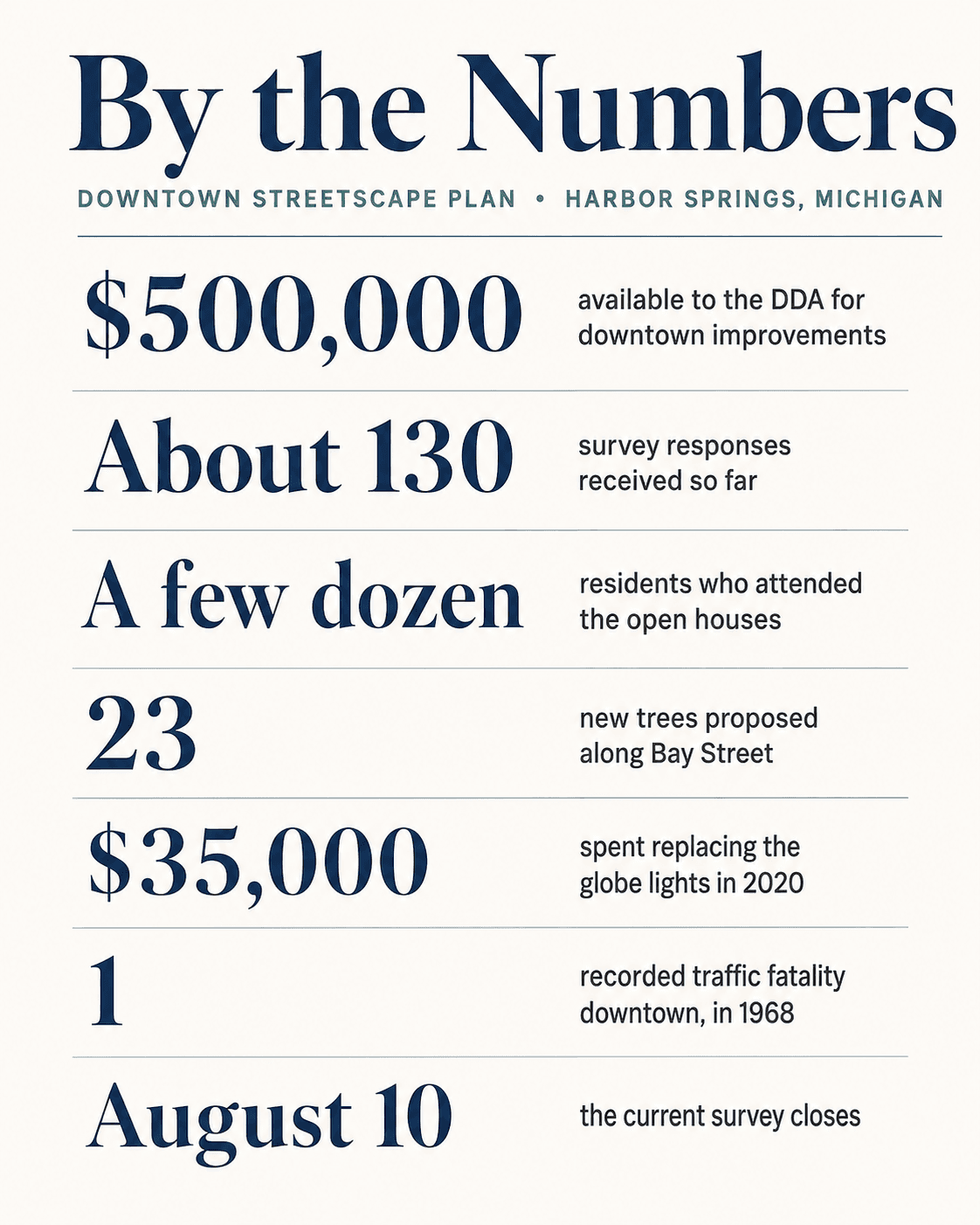
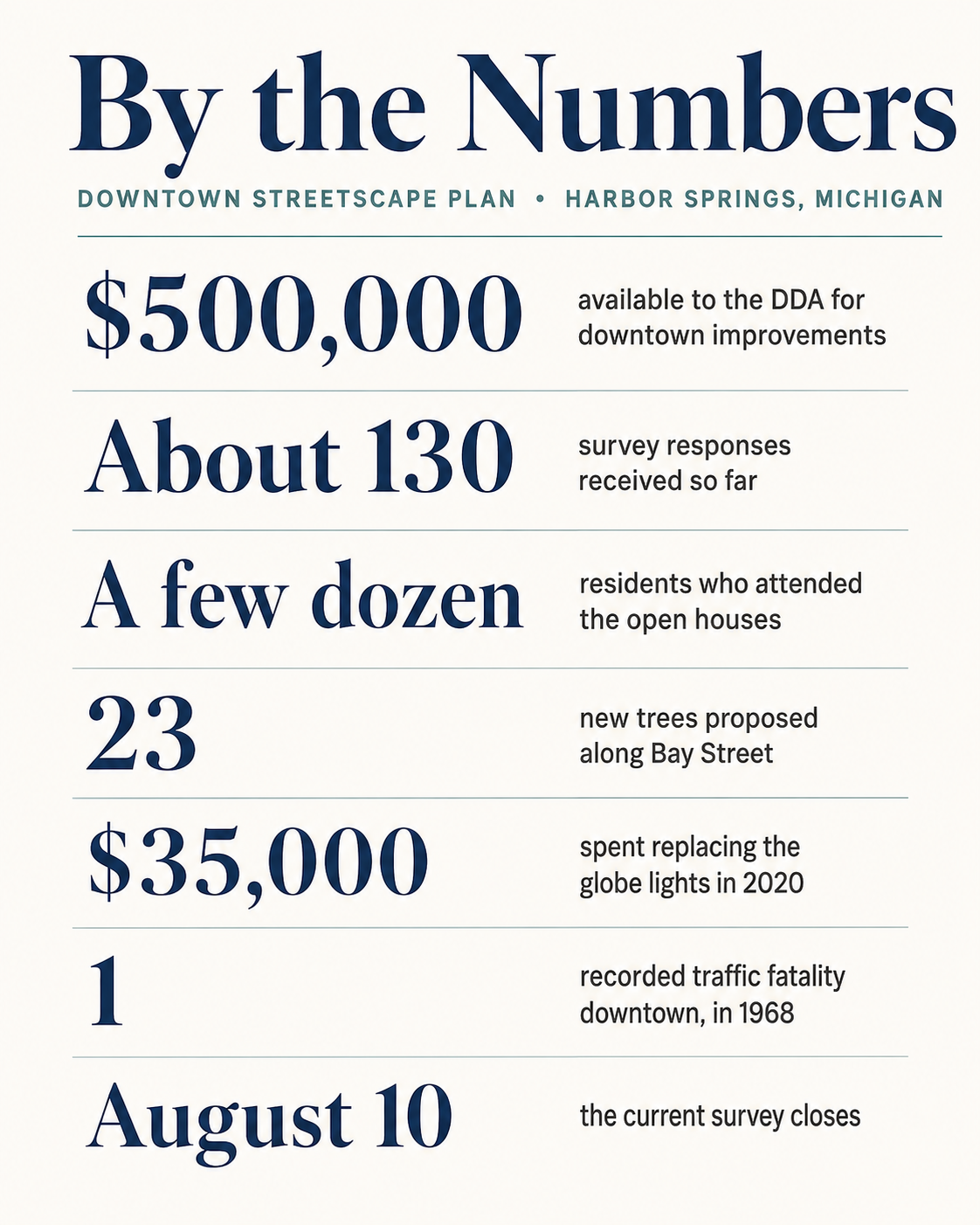
The DDA has budgeted $500,000 for downtown infrastructure improvements. How it gets spent is still being worked out. Meanwhile, the community is debating whether to change the plan or get rid of the DDA. Lots of big decisions brewing. In this newsletter, we are pointing out how you can influence the capital improvement plan towards improvements downtown genuinely needs.
At the July 30 meeting, a DDA member said they keep asking for feedback, and only a few give it. That is half right. The DDA’s survey has drawn about 130 responses.
This newsletter is read by roughly 1,800 people every time we send one. So, give them the feedback they seek. Your job if you care about Harbor Springs….
-
Respond to the DDA Survey. The survey asks you to comment on the plan as it stands. It is difficult to give alternate opinions.
-
Email the DDA with your thoughts: ddadirector@cityofharborsprings.com. You can view the project website for more information.
Now to the Story…
What exists today is only the beginning of a plan. The plan is fluid. Here are a few examples of the discussion….
-
Curb bumpouts at the corners: safer crossings, or lost parking and tighter turns for plows, delivery trucks, and fire equipment?
-
Fix what’s broken: New lighting and signage, or sidewalk repair, tree irrigation, and underground power lines?
-
A change to character: A clear view of the waterfront or 23 new trees along Bay Street?
-
Tourists or Residents: More garbage for ice cream cones vs easier snow removal
More Details…
At the July 30 Downtown Development Authority meeting, from 5–7 PM, Beckett & Raeder landscape architects presented preferred concepts for three downtown character zones: Bay Street/waterfront, Main Street/central downtown, and Third Street/downtown neighborhood.
Beckett & Raeder was clear that this is still a master plan draft: an early framework, not a final design, with more public feedback and several design stages ahead before anything is built. The process is early enough to be redirected, and it will only come into proper focus if the community gives the DDA much stronger and more specific direction.
Beyond the design questions, residents raised concerns the plan doesn’t yet answer: marina and towing access, winter snow removal and storage, parking lot safety, where bike parking goes, and whether year-round curb extensions fit a town like Harbor Springs. Several also questioned how far the survey actually reached. As an early guiding plan, its eventual priorities could shape downtown sidewalks, trees, lighting, parking, and street geometry for years to come.
Here is an example of the changes under consideration…..
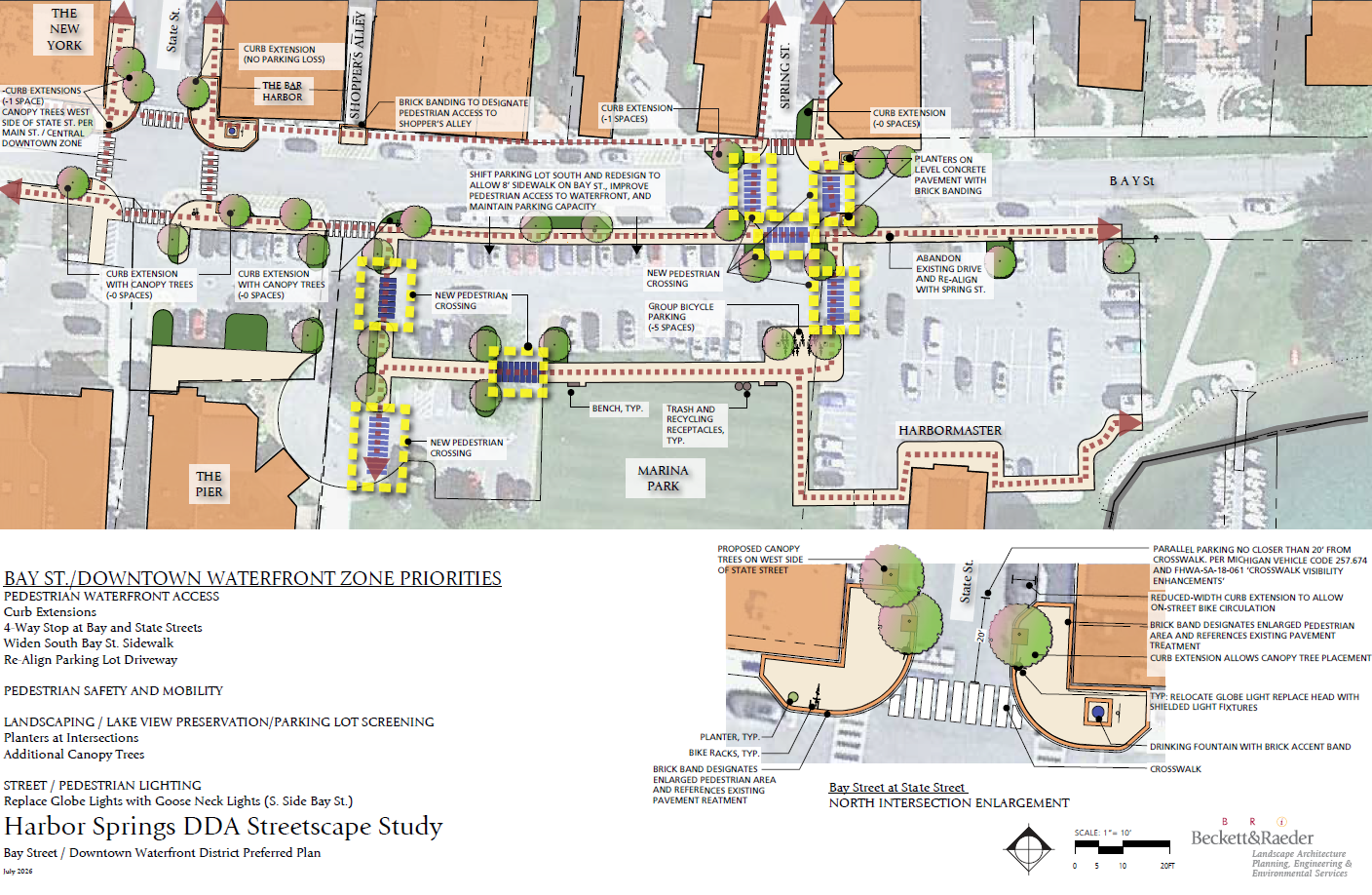
Example Changes on Bay Street
Harbor Springs Dda Streetscape Preferred Plan Showcase Presentation
Downtown Streetscape Master Plan
Community Feedback
Wendy Reeve - City Council: Wendy raised a series of pointed objections to the preferred plan, grounding her concerns in traffic safety, fiscal history, and community sentiment rather than general opposition.
-
Pedestrian safety. She challenged the plan’s core premise on its own terms: relocating the parking lot exit into the Spring Street intersection doesn’t reduce pedestrian conflict, it concentrates it. Routing turning vehicles into the same zone as the new waterfront crosswalks works against the plan’s stated safety goals. Leaving the exit in its current, lower-traffic location, she argued, is the safer design.
-
Design proportionality. She counted 23 trees proposed along Bay Street and raised a sightline concern: dense canopy at that density risks obstructing the bluff water views that are part of what draws people downtown in the first place — undercutting one of downtown’s core visual assets in the name of beautification.
-
Parking as infrastructure, not amenity. She opposed any net loss of parking spaces, framing it as a practical access issue rather than a preference — specifically flagging winter accessibility for elderly residents who depend on close, reliable parking. Reallocating spaces to bike racks, she noted, trades a need used year-round for a use that’s seasonal at best in northern Michigan.
-
Fiscal accountability. She cited the 2020 globe light replacement — roughly $35,000 — as the DDA’s sole tangible output that year, using it as evidence for why further discretionary spending on dark-sky lighting upgrades deserves scrutiny before approval, not after.
-
Reading the room accurately. She pointed out that at the DDA’s July board review — which drew a larger turnout than this meeting — not a single attendee spoke in favor of curb bumpouts. She used this as direct evidence that the plan, as presented, doesn’t reflect community consensus, regardless of how it’s being framed procedurally.
-
Testing the safety rationale. She referenced the 1968 traffic fatality on Main Street, the only one in the city’s known history, and made the case that the circumstances of that incident wouldn’t have been prevented by curb bumpouts — directly challenging whether the plan’s safety justification holds up against the town’s actual accident history.
Homework: What Comes Before the Streetscape
If the survey results give the DDA and Beckett & Raeder a clear signal — genuine consensus on specific elements, not just a split vote — then the planning process can move forward on that basis.
If that doesn’t happen, the DDA should shift attention away from bumpouts, tree wells, and dark-sky lighting debates and toward the foundational infrastructure that everyone, regardless of where they land on the streetscape design, actually agrees needs attention.
At the July 30 meeting, one resident put it simply: the plan needed to be broken down into prioritized categories, starting with foundational infrastructure, because the volume of design detail was overwhelming and hard to weigh in on meaningfully. That’s a reasonable request, and it points to a practical first step — one that doesn’t require another contentious survey or another expensive round of design work.
Start with an inventory.
Before the DDA commits more money and time with Beckett & Raeder to refining a streetscape plan the community hasn’t clearly endorsed, it makes sense to know what we’re actually starting with. A basic downtown inventory would answer questions the DDA, the public, and the City Council don’t currently have clear numbers on:
Trees
-
How many street trees does downtown currently have?
-
How many have died or been removed in recent years, and where?
-
How many existing trees have automatic irrigation, and how many don’t?
-
Of the trees without irrigation, how many are showing stress or decline?
Lighting
-
How many globe lights are currently installed downtown?
-
How many other light fixture types (Shepherd’s hook, etc.) are in use, and where?
-
What is the actual condition and remaining lifespan of the existing fixtures?
Sidewalks
-
How many blocks of sidewalk are newer and in good condition?
-
How many sections need repair, and where specifically are they located?
-
Which of those repairs are urgent (safety hazards) versus cosmetic?
Utilities
-
How many linear feet of overhead utility line downtown could be moved underground?
-
What is a realistic cost estimate per foot, and a total price range, for undergrounding?
-
Which corridors (e.g., Third Street) are the highest community priority given tree canopy or sightline impact?
Signage
-
How many stop signs currently exist downtown?
-
How many new stop signs are being proposed, and what will all these stop signs cause for traffic flow?
-
Given that sign pollution has come up repeatedly in past Vision Documents and surveys, how does this proposal weigh added signage against that existing community concern? Tying back to the “sensory overload” concern that DDA Board Member Maggie Lacy raised at the Open House.
If the survey results are inconclusive, this is where the DDA’s next dollar should go:— not into further streetscape design, but into knowing exactly what we’re working with.
This kind of inventory isn’t glamorous, and it won’t produce a rendering people can react to at an open house. But it gives the DDA and the City Council a factual baseline to prioritize spending against, instead of designing infrastructure improvements for conditions that haven’t been documented.
The survey closes August 10. Take the survey here.
The DDA will build what people tell them to build. If you tell them.
What’s the one thing you’d fund first — sidewalk repair, tree irrigation, or burying the power lines? Tell us in the comments, and tell the DDA directly at ddadirector@cityofharborsprings.com.