

From: Williams, Carter <carter@oiventures.com>
Sent: Wednesday, December 10, 2025 1:13 PM
To: Tom Graham <tom@grahamre.com>; kathy.motschall@yahoo.com; Jamielynnmelke@gmail.com; Reeve 4 HS Council <wendy@reeve4hscouncil.com>; Jeanne Benjamin, <jjmb1011@yahoo.com>
Cc: Victor Sinadinoski <citymgr@cityofharborsprings.com>; Kyle Knight <KKnight@cityofharborsprings.com>; NW Whitaker <cityclerk@cityofharborsprings.com>
Subject: 2026 Budget
Mayor Graham and City Council,
I had a moment to listen to Monday’s budget discussion. I had a few thoughts on changes we should make to the budget. I am sharing with you my review of the proposed FY2026 budget and CIP. The analysis is offered constructively. The goal is a budget that balances without relying on uncertain revenues and provides clearer accountability for major commitments like the electric utility bond and DDA spending. While you are likely not required to follow GAAP, it’s a good practice.
The analysis identifies several areas where tighter alignment with GAAP principles and clearer strategic guidance would benefit the City. The core recommendations are straightforward:
Balance the budget without relying on uncertain FEMA revenue
2. Remove unfunded projects from the operating budget; keep them in the CIP as contingent
3. Require a 10-year pro forma before finalizing the electric utility bond
4. Establish measurable KPIs for the DDA before approving their budget
5. Invest in citizen communications infrastructure to reach 90%+ of property owners and voters
Happy to discuss any questions,
Respectfully,
Note: Please include in CC packet for the next meeting.
Click on this LINK to download letter in entirety HS 2026 Budget Analysis
CITIZEN BUDGET REVIEW BY CARTER WILLIAMS 12.10.25
City of Harbor Springs, Michigan
Fiscal Year 2026 Proposed Budget
December 2025
Purpose and Limitations
This memo is offered in the spirit of a citizen management letter—highlighting areas where
closer alignment with Generally Accepted Accounting Principles (GAAP) and government
finance best practices could strengthen the City’s budget presentation and fiscal planning.
Important Disclaimer: This review was conducted with limited time and access to
underlying documentation. I may have missed context, corrections, or explanations that
would address the observations below. Staff and Council are far more familiar with the
details than I am, and I welcome correction on any point where I have misunderstood the
situation.
The intent is not to criticize staff effort—preparing a budget for a city with this level of
complexity (municipal electric utility, DDA, waterfront, capital plan) is substantial work.
Rather, this memo suggests ways to strengthen governance and transparency that would
benefit any municipality of our size.
Context: Harbor Springs has a year-round population of approximately 1,200 residents, with
significant seasonal fluctuation. The City operates its own electric utility, maintains waterfront
facilities, and supports a tourism-oriented downtown through a Downtown Development
Authority (DDA).
Summary
Based on my review of the proposed FY2026 budget and the December 8, 2025 Council
discussion, I identified several areas where GAAP best practices suggest modifications.
These relate primarily to revenue recognition, capital project authorization, liability accrual,
and enterprise fund oversight.
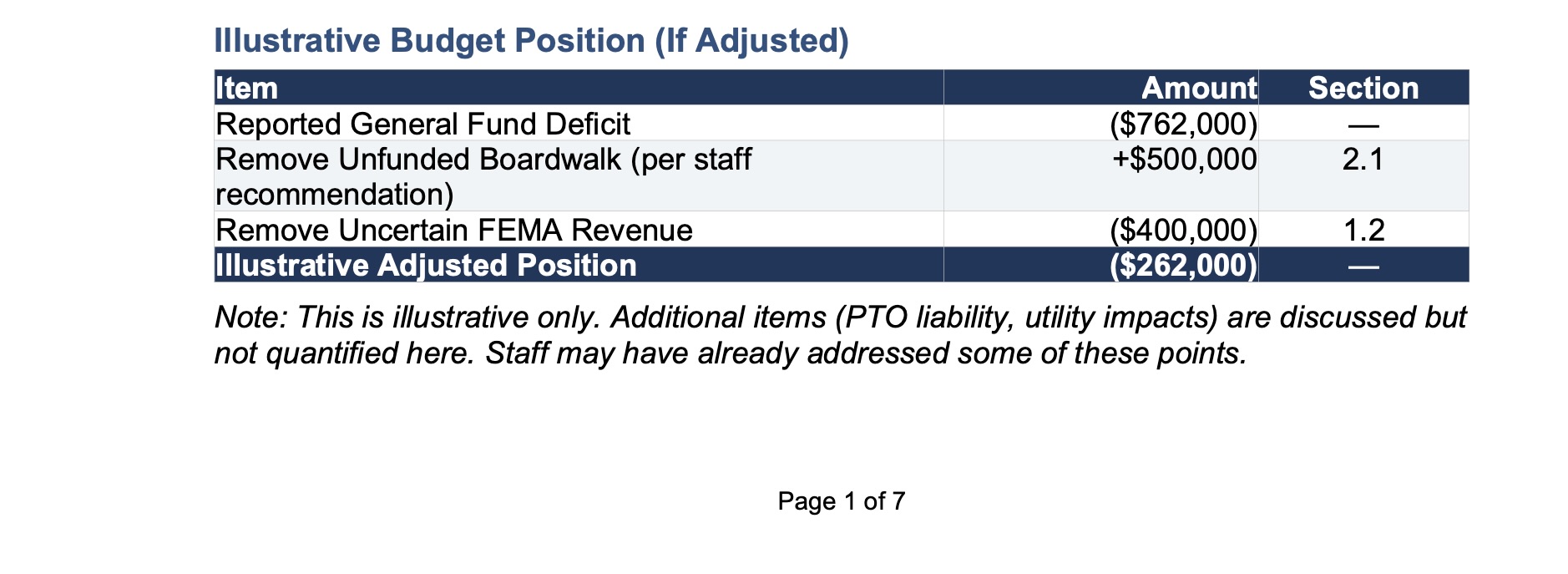
The budget as presented shows a General Fund deficit of $762,000. However, this figure
includes a $500,000 boardwalk project that staff recommends removing, and $400,000 in
FEMA revenue whose timing and amount remain uncertain. Adjusting for these items would
significantly change the reported position.
The recommendations below are offered as suggestions for Council’s consideration,
grounded in GAAP principles and best practices from the Government Finance Officers
Association (GFOA).
Illustrative Budget Position (If Adjusted)
Section 1: GAAP Best Practices – Revenue and Liability
Recognition
GAAP and GFOA best practices provide a framework for consistent, conservative financial
reporting. The following observations highlight areas where closer alignment with these
standards could strengthen the budget presentation.
1.1 Accrual of Compensated Absences (PTO)
GAAP Standard: GASB Statement No. 16 requires governments to accrue a liability for
compensated absences (vacation, sick leave, PTO) that are attributable to services already
rendered and are not contingent on a specific event.
Best Practice Rationale: Accruing these liabilities annually ensures that current taxpayers
fund the benefits earned by current employees, rather than creating budget surprises when
long-tenured employees retire.
Observation from December 8 Meeting:
• Discussion indicated that a retiring officer’s PTO payout plus healthcare buyout
totaled approximately $160,500
• Staff noted that PTO can accumulate up to six months and payout percentages vary
by tenure
• This suggests the City may be using cash-basis recognition for these obligations
Suggestions for Consideration:
1. Calculate and disclose total accumulated PTO liability across all funds
2. Consider establishing an Employee Benefit Reserve Fund with annual contributions
3. Publish an annual schedule showing total liability and year-over-year changes
1.2 Recognition of Contingent Grant Revenue (FEMA)
GAAP Standard: GASB Statement No. 33 requires that grant revenue be recognized only
when eligibility requirements are met and resources are measurable and available. Until a
grant is formally awarded and funds obligated, the revenue is considered a contingent asset.
Best Practice Rationale: Conservative revenue recognition protects against budget
shortfalls if expected grants are delayed or denied. This is particularly important for FEMA
reimbursements, which can take months or years to process.
Observation:
• The budget includes $400,000 in anticipated FEMA reimbursement (approximately
9% of General Fund revenue)
• Staff indicated uncertainty about timing: “That could be 10 days, it could be two
years”
• Some permanent work claims have already been denied
• Grant is currently in “final signature in review” with State Emergency Management
Suggestions for Consideration:
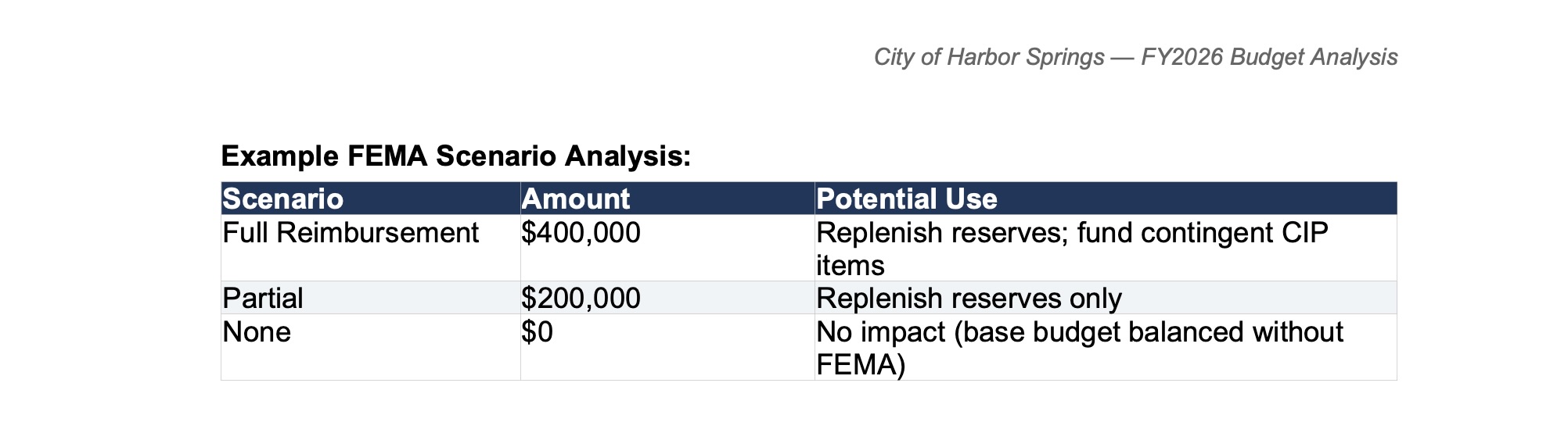
1. Consider presenting a base budget that balances without FEMA revenue
2. Identify specific projects or reserve replenishment that would be funded if FEMA is
received
3. Consider adopting a policy that FEMA funds first replenish reserves drawn down for
storm response
4. Present scenario analysis (full/partial/no FEMA) to help Council and citizens
understand the range of outcomes
Page 2 of 7City of Harbor Springs — FY2026 Budget Analysis BY CARTER WILLIAMS
Section 2: Capital Improvement Plan Structure and Transparency
GFOA best practices recommend that capital budgets clearly distinguish between funded
and unfunded projects, and that aspirational projects not be included in appropriations until
funding is secured.
2.1 Contingent Projects in the Operating Budget
Best Practice: Capital projects that depend on external funding (grants, donations) should
not appear as appropriations in the annual operating budget until funding is contractually
committed. Including them creates a misleading deficit narrative.
Observation:
• The budget includes a $500,000 boardwalk project without corresponding revenue
• Staff recommended removing this item: “We’re not showing any revenue coming in
donations in 2026″
• City Manager stated: “My recommendation there is to remove the boardwalk from
this budget”
Suggestion: Follow staff’s recommendation to remove the $500,000 boardwalk expenditure
from the operating budget. Keep it in the CIP as a contingent project to be initiated when
sufficient donations and/or grants are secured. Post the CIP on City website along with
budget. If there are important unfunded elements, include the logic/concern/outreach for
funds via city newsletter/facebook/website.
2.2 Restricted Fund Reconciliation
Best Practice: Restricted funds should be fully reconciled before authorizing new spending,
with clear documentation of receipts, expenditures, and current balance.
Observation:
• There appears to be some uncertainty about the current boardwalk fund balance (Not
sure I have this right, it was hard to distinguish in the transcript)
• Historical audit records and current reported balances may warrant reconciliation
Suggestion: Before any future boardwalk spending is authorized, consider presenting a
complete reconciliation showing: total donations received by year, expenditures to date,
current restricted balance, and any transfers or reclassifications.
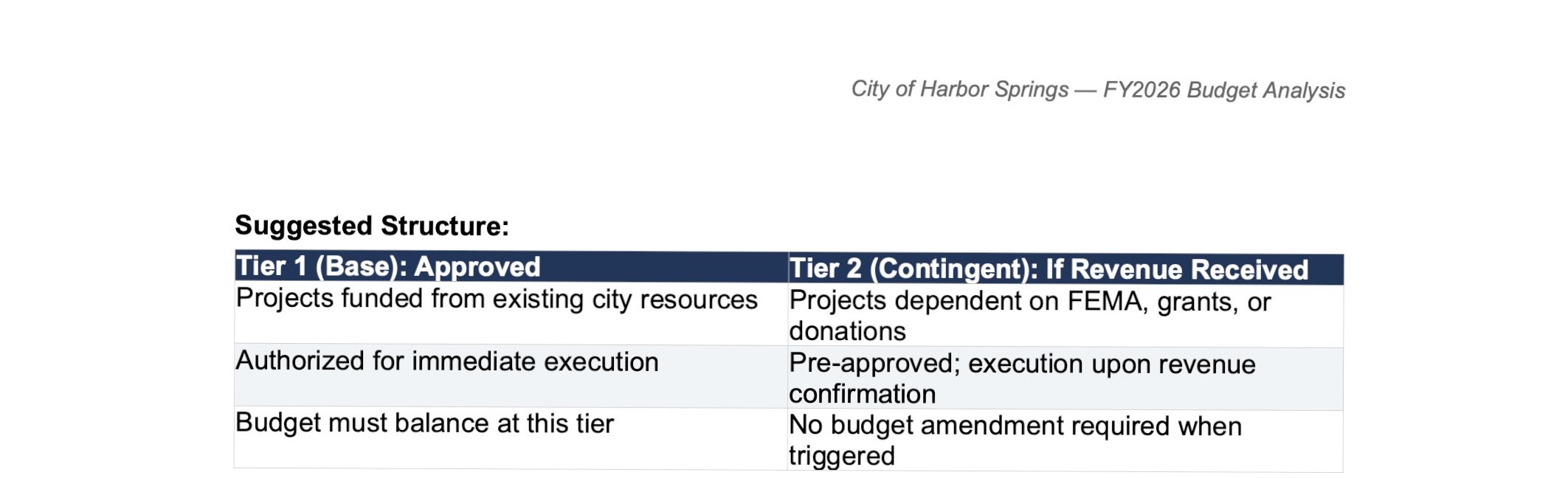
2.3 Tiered CIP Approach
Best Practice: GFOA recommends that capital plans clearly distinguish between projects
that are funded and ready for execution versus those that are contingent on future
resources.
Page 3 of 7 City of Harbor Springs — FY2026 Budget Analysis BY CARTER WILLIAMS
Suggested Structure:
Benefit: This approach maintains fiscal discipline while allowing rapid execution of deferred
projects when revenue materializes, without requiring a budget amendment. Post a memo
explaining the tiered approach on city website
2.4 CIP Publication and Strategic Guidance
Best Practice: GFOA recommends publishing the full CIP alongside the annual budget, with
clear status indicators for each project.
Suggestions:
1. Publish the CIP on the City website with projects clearly labeled as Funded,
Contingent, or Unfunded
2. For unfunded items, include estimated cost and anticipated funding sources
3. Consider providing Council guidance on strategic priorities (e.g., relative emphasis
on resident infrastructure vs. tourism amenities) to help staff rank and sequence
projects consistently
Benefit: Transparency allows citizens to see not just what the City can afford this year, but
what it aspires to do over time. Residents can provide informed input on priorities.
Section 3: Electric Utility Fund Oversight and Reporting
The proposed $8 million utility bond authorization represents a significant commitment for a
city of 1,200 year-round residents. GFOA best practices suggest that enterprise fund
borrowing of this magnitude warrants detailed analysis and enhanced oversight.
3.1 Bond Sizing and Debt Service Planning
Observation:
• $8 million authorized, though final engineering is not complete
• Staff indicated a preference to bond for $6 million if possible
• The method for funding debt service (rate increases vs. General Fund support)
appears undetermined
• Council discussed eliminating the $245,000 annual Electric Fund transfer to General
Fund
Suggestion: 10-Year Pro Forma
Before finalizing bond size and rate decisions, consider presenting a 10-year Electric Fund
pro forma including:
1. Forecasted operating revenues and expenses
2. Planned capital expenditures beyond current projects
3. Proposed bond structure and debt service schedule
4. Planned transfers to General Fund (if any)
5. Projected debt service coverage ratios
Page 4 of 7City of Harbor Springs — FY2026 Budget Analysis
6. Target minimum fund balance and reserve requirements
3.2 Transfer Policy
Best Practice: Transfers from enterprise funds to the General Fund should be based on a
clear, documented policy rather than ad hoc decisions. The policy should include safeguards
to protect utility financial health. Policy should be posted on city website.
Suggestion:
• Consider formalizing the transfer policy with a defined formula (e.g., percentage of
revenues or net plant)
• Include automatic safeguards: if debt service coverage or fund reserves fall below
target thresholds, transfers are reduced or suspended
• Document the General Fund impact under different transfer scenarios
3.3 Emerging Risks and Oversight
Observation:
• The City recently sold a Power Purchase Agreement, suggesting active capacity
management
• Seasonal population fluctuation (1,200 to potentially 5,000+) creates variable peak
demand
• Regional trends toward electrification (heat pumps, EVs) may increase future load
and increased supply of renewables may make supply intermittent.
• There does not appear to be regular, formal utility reporting to Council beyond budget
documents. Council is running a utility, and needs to oversee it properly.
Suggestions:
1. Quarterly Reporting: Consider establishing quarterly or semi-annual Electric Fund
reports to Council covering demand trends, capacity utilization, project status, and
fund balance
2. Advisory Input: Given the complexity of utility operations, consider engaging an
informal advisor, perhaps a retired utility executive residing in the community, to
review the bond business case, load assumptions, and rate impact before debt is
incurred
3. Load Analysis: Survey community on the rate at which it is moving more electric.
And/Or discuss with HVAC contractors. The shift to more electric was a reason for
the multi-day winter blackout in Texas.
Section 4: DDA Accountability Framework
The Downtown Development Authority spends approximately $270,000 annually, funded
largely by TIF capture (~$181,000) and special assessments. GFOA best practices suggest
that entities receiving dedicated tax revenue should demonstrate measurable outcomes.
4.1 Performance Measurement
Best Practice: Organizations funded by dedicated revenue streams should establish Key
Performance Indicators (KPIs) that connect spending to outcomes, allowing stakeholders to
evaluate return on investment.
Observation:
• The DDA budget presentation focused on activities (events, beautification,
marketing) rather than outcomes
Page 5 of 7 City of Harbor Springs — FY2026 Budget Analysis BY CARTER WILLIAMS
• No KPIs were presented to measure effectiveness
• Fund balance is approximately $430,000 (growing) with no stated deployment plan
Suggestion:
Before approving the FY2026 DDA budget, Council might ask the DDA to propose a small
set of KPIs and provide a good-faith estimate of current performance against those metrics.
This need not be onerous—even simple measures like commercial vacancy rate, year-round
vs. seasonal business count, or taxable value growth would provide baseline accountability.
4.2 Example KPIs (Illustrative)
The following are examples only—final metrics should be developed collaboratively
between Council and DDA:

Section 5: Citizen Communications
Effective communication is essential for democratic governance. The population varies
greatly, and the part time residents do represent a substantial aspect of revenue. Given
Harbor Springs’ small full time population, and engaged part time population, achieving high
coverage is feasible at relatively low cost.
5.1 Current Challenges
• Audio/visual reliability issues noted during Council meetings
• No comprehensive email/text notification system for budget hearings or major
decisions
• Seasonal residents may miss important information
5.2 Suggestions
The budget includes $60,000 for A/V upgrades. Consider whether a portion of this could
fund active engagement systems:
1. Notification Platform: A mass notification system (email/SMS) capable of reaching
residents and property owners for major announcements
2. Contact Collection: Make email/phone collection a standard part of utility account
management and permitting
3. Coverage Target: Consider setting a goal to have 90% of utility accounts with valid
contact information within 2-3 years. Current technology may be sufficient, so a
coverage taget may be the missing element to an effective communications strategy.
4. Major Initiative Commitment: For significant decisions (budget, rate changes,
zoning), commit to direct mailing plus electronic notification plus clear website
postings
5. Measure: Use Net Promoter scoring to validate outcomes of communications
engagement. All KPIs for communications should be based on results not effort
Page 6 of 7City of Harbor Springs — FY2026 Budget Analysis
Section 6: Summary of Suggestions
The following suggestions are offered for Council’s consideration, grounded in GAAP and
GFOA best practices. Staff may have already addressed some of these points, and I
welcome correction where I have misunderstood.
Budget Adoption Considerations
1. Remove $500,000 boardwalk expenditure per staff recommendation; keep in CIP as
contingent
2. 3. 4. 5. Consider presenting a base budget that balances without $400,000 FEMA revenue
Adopt tiered CIP: Tier 1 (funded) and Tier 2 (contingent on external revenue)
If FEMA is received, consider prioritizing reserve replenishment before new projects
Request DDA propose KPIs and baseline performance estimate before budget
approval
Near-Term Process Improvements
6. 7. 8. 9. Calculate and disclose total PTO liability; consider establishing benefit reserve fund
Complete 10-year Electric Fund pro forma before finalizing bond decisions
Consider quarterly utility reporting to Council
Formalize Electric Fund transfer policy with coverage safeguards
10. Publish CIP on website with funding status clearly labeled
11. Launch citizen notification enrollment campaign
Strategic Guidance
• Consider providing explicit Council guidance on CIP priorities (resident infrastructure
vs. tourism amenities)
• Clarify DDA mission expectations: business development vs. placemaking vs. capital
improvements
• Consider engaging informal utility advisory input before major bond decisions
Harbor Springs is a small city with sophisticated responsibilities: a municipal electric utility,
an active DDA, waterfront facilities, and a capital plan that would not be out of place in a
larger community. These suggestions are intended to help align the budget more closely
with GAAP best practices and strengthen transparency for the 1,200 year-round residents
who depend on these decisions.
Again, I had limited time to review these materials and may have missed important context. I
welcome correction on any point and appreciate the substantial work that staff and Council
invest in the City’s governance.
Thank you for considering these observations.
Carter Williams
355 East Bay Sreet
Harbor Springs, MI 49740
Page 7 of 7
Common ways cities handle longer submissions
Many councils use one of these approaches:
A. Page limit for the main packet, with attachments allowed
Example:
-
1–2 page letter in the agenda packet
-
Full 7-page analysis included as an attachment or appendix
-
Or posted online as “Correspondence Received”
B. Summary + full document on file
-
Council receives a summary
-
Clerk keeps the full analysis on record
-
Full version is public and FOIA-able
C. No formal limit, but discretion by staff
-
Clerk decides what goes into the packet
-
Everything is still “received,” even if not printed in full
4. What cannot happen
Even if the city limits packet length:
-
❌ They cannot refuse to accept your letter
-
❌ They cannot discard or ignore it
-
❌ They cannot prevent Council from receiving it
-
❌ They cannot block it from the public record
If submitted on time, it is public correspondence.