
Dear Readers, We know there are a lot of details to sort out – and through – but to get it right, thats what needs to be paid attention to.
Opening Thought: Clear zoning language is not about stopping development. It is about making sure that what gets built—once permits are closed—still feels like Harbor Springs.
Purpose
To ensure correct decision-making, adherence to State law and the City Charter, and to avoid placing the City, its residents, and taxpayers at risk. While parking will be discussed to build consensus, the community is also asking for a deep dive review of the three items that were agreed to for deeper discussion at the Planning Commission’s first January meeting:
- Planned Developments (PDs)
- Heights and grades
- Final clarification of Administrative Review Committee (ARC) language
- Parking – Let’s all catch up on this subject. Can the realtors be asked to join in on the conversations?
This is not an oppositional argument. It is a protective one.
In Harbor Springs, the risk is not dramatic overdevelopment. The real risk is incremental approvals that permanently change scale and character while technically “following the rules”.
Modern zoning tools are often designed to prepare communities for future growth. What Harbor Springs is asking for now are ordinances that protect what already exists. We are fully aware that Beckett & Raeder does not work for the community, but we are hoping the planner is working for Harbor Springs, via the City Council.
Below are real life examples framed around why protection matters in Harbor Springs, not why planners are “wrong.”
1. PLANNED DEVELOPMENTS (PDs)
Planned Developments are powerful tools. Without tight language, they shift zoning from standards to negotiation.
Key concern: In Harbor Springs, one PD does not just affect one parcel—it sets the tone for what comes next.
Real-Life Examples (What This Looks Like on the Ground)
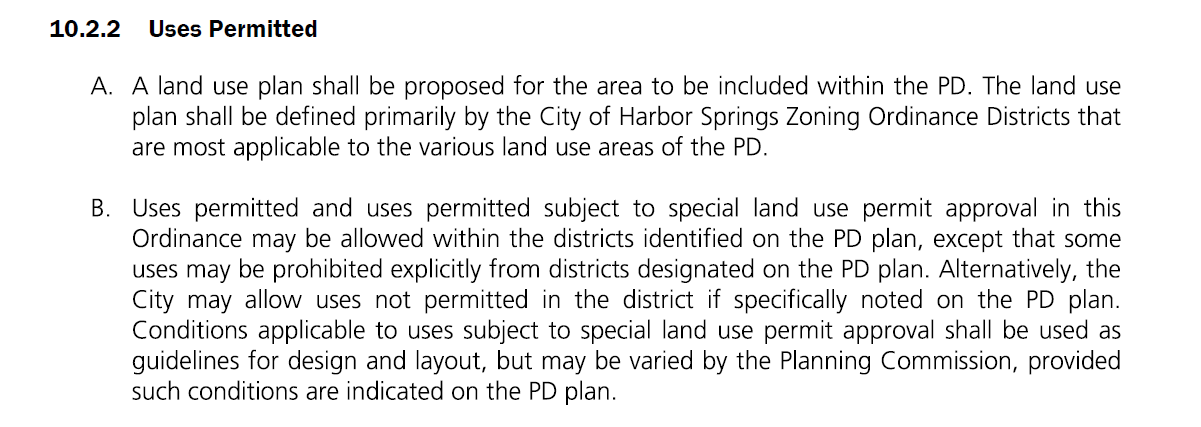
ADDITIONAL DETAIL: The approved PD ordinance, as it is written, would allow someone to propose uses that are not permitted in the underlying district. Say the district allows only single family detached homes (AR district), someone can proposed duplex or multifamily.
1. The “Temporary Fit” PD That Becomes Permanent
- Approved as appropriate “at this time”, notice the phrase “at this time” used in Beckett & Raeder memo’s
- Framed as an exception
- Becomes precedent for future proposals
Why This Matters Here
In a town as small as Harbor Springs, a single Planned Development can redefine expectations for an entire neighborhood. Language tied to timing rather than fixed criteria creates uncertainty and invites repeat exceptions.
Gauge question: Does the PD standard rely on temporary circumstances—or permanent protections?
2. The PD That Quietly Overrides Base Zoning
- Deviations allowed for height, density, setbacks, or parking
- Base zoning becomes a suggestion
- Predictability erodes
Why This Matters Here
Predictability is one of Harbor Springs’ strongest protections. When PDs routinely override base zoning, residents lose confidence that adopted standards actually mean something.
Gauge question: Is the PD enhancing zoning—or replacing it?
3. The PD With Cumulative Impacts No One Modeled
- Reduced parking or increased intensity approved
- Impacts spill into surrounding streets
- Public benefit is difficult to measure or enforce
Why This Matters Here
Harbor Springs’ streets, parking, and infrastructure reach capacity quickly. When cumulative impacts are not clearly modeled or limited, residents experience the effects daily.
Gauge question: Does the PD require measurable, enforceable public benefit—or rely on narrative?
2. HEIGHTS: “Out-of-Scale by Right”
Worst-Case Scenario
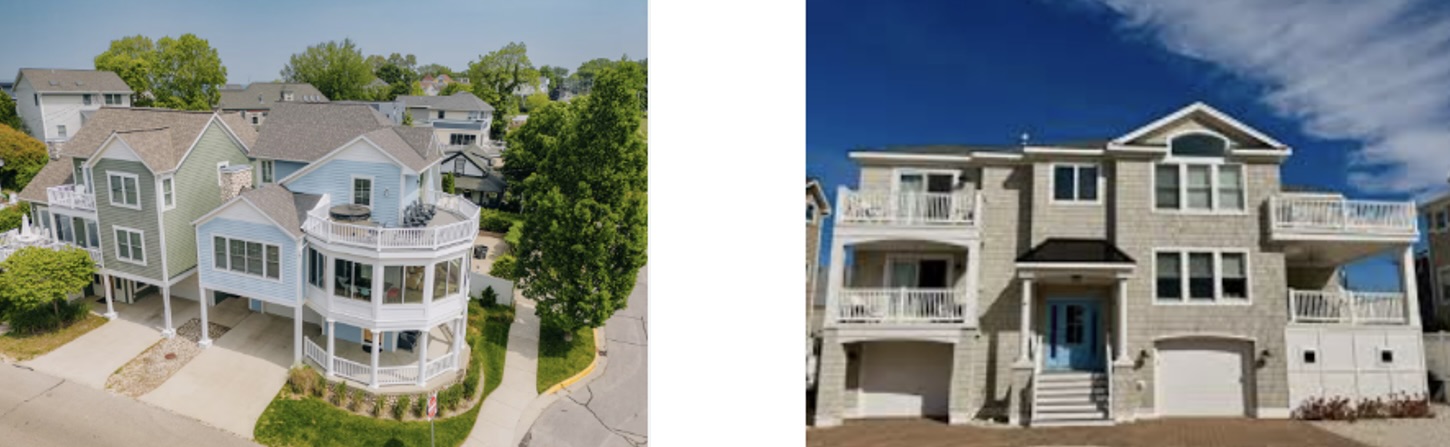
Most folks don’t view buildings by feet and inches. Could any of us be able to say which homes are 27’, 30’ or 35’? Likely not. But we can read a building when we see stories…one story, two story, three story. We can also read a building in terms of a pitched roof and a flat roof, and we can tell when a building is similar to its neighboring buildings and when it stands out.
What This Looks Like in Practice
- A structure meets height limits numerically but dominates adjacent homes due to massing, roof form, or grade manipulation.
- Neighbors are told, “It meets the ordinance,” even when neighborhood character is clearly affected.
- Once built, there is no practical remedy.
- Clear height language isn’t about stopping development—it’s about making sure what gets built still feels like Harbor Springs after the permits are closed.
Why This Matters Here
Height is not just a number. It affects views, sunlight, privacy, and the human scale of streets that were never designed for oversized structures. Without clear guardrails, enforcement becomes defensive instead of protective.
Plain takeaway: If stories are not regulated back to 2 ½ in residential and commercial, we could impact community character.
Real-Life Examples (What This Looks Like on the Ground)
1.The “Compliant but Overwhelming” House
- Height measured from the lowest allowable point or averaged corners
- Tall foundation plus steep roof remains “within the number”
- Neighbors lose light, privacy, and scale
Why This Matters Here
Many Harbor Springs neighborhoods were built before modern height calculations existed. Without clear limits on massing, roof form, and grade, height becomes a technical exercise rather than a safeguard for neighborhood character.
Gauge question: Does the height standard protect neighborhood scale—or just numeric compliance?
2. The View Corridor Loss
- A compliant structure blocks long-standing harbor, lake, or bluff views
- No step-back or view protections apply
- Loss is permanent
Why This Matters Here
Views are a defining feature of Harbor Springs and shape long-standing expectations for residents and visitors alike. Once a view corridor is lost to a compliant building, it cannot be restored, and the impact is felt far beyond a single parcel.
Gauge question: Does the height language recognize Harbor Springs’ topography and view sensitivity?
3. The Downtown “One More Story” Effect
- A small increase approved as reasonable
- Approval becomes precedent
- Downtown scale quietly shifts over time
Why This Matters Here
Harbor Springs’ downtown is compact and human-scaled. Even small height increases compound quickly, altering shadows, views, and the pedestrian experience in ways that are permanent.
Gauge question: Below are concrete, real-world ways this plays out—and why zoning protection matters here, not in theory. Harbor Springs doesn’t need dramatic over-development to lose its character. It only needs small, repeated allowances that add up over time. Strong height standards—including clear story limits—are not anti-development. They are the mechanism that ensures growth happens without quietly changing the place we’re trying to protect.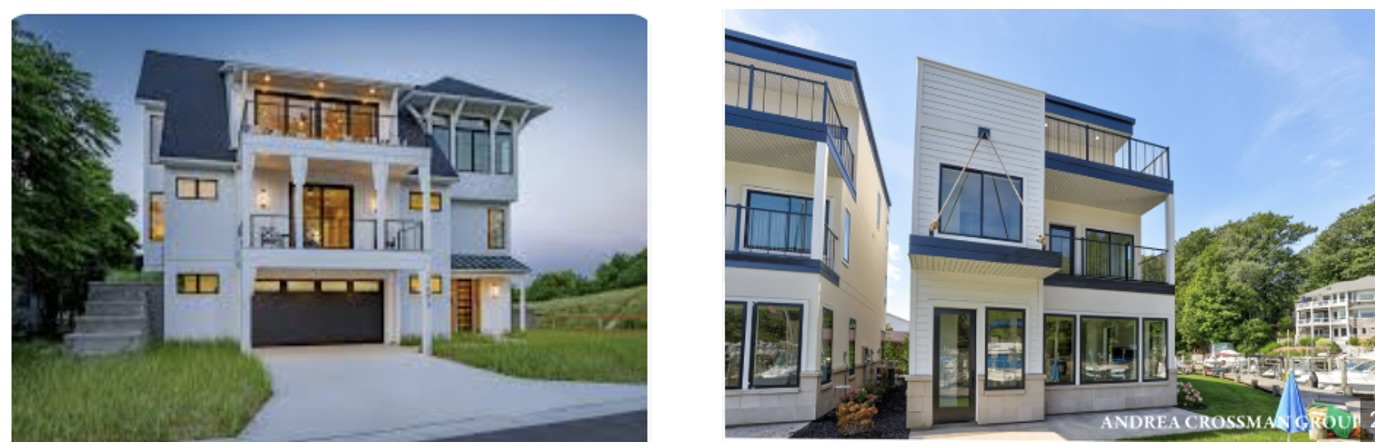
3. ADMINISTRATIVE REVIEW COMMITTEE (ARC) See attached Research below
ARC was intended as a clean-up tool after Planning Commission approval—not a pressure valve for avoiding public review.
When administrative review expands quietly, the community experiences change before it understands it.
Real-Life Examples (What This Looks Like on the Ground)
1. The “Minor Change” That Wasn’t Minor
- Post-approval changes labeled minor
- ARC approval alters footprint, massing, or scale
- Neighbors see a different building than what was approved
Why This Matters Here
In a small community, visual and scale changes do not need to be large to be meaningful. When “minor” is undefined, ARC can unintentionally allow significant changes without public awareness.
Gauge question: Does ARC clearly limit review to truly minor changes—or leave room for interpretation?
2. The Quiet Shift Away From Public Review
- More items routed to ARC over time – notice the phrase “at this time” used in Beckett & Raeder memo’s
- Fewer returns to Planning Commission
- Public learns after permits are issued
Why This Matters Here
Public review is a core safeguard in Harbor Springs. When decisions gradually move out of public view, trust erodes even if each individual decision seems small.
Gauge question: Is ARC reinforcing Planning Commission authority—or slowly replacing it?
3. The Threshold Becomes the Rule
- Numerical limits (e.g., 5,000 sq ft) drive decisions
- Projects designed to stay just under the threshold
- Context and neighborhood impact are secondary
Why This Matters Here
Numeric thresholds are blunt tools. In a town the size of Harbor Springs, context matters more than numbers. When thresholds drive outcomes, neighborhood character can erode incrementally.
Gauge question: Does the ARC threshold protect neighborhoods—or invite edge-case design?
ATTACHED ++++++++++++++++++++++++++++++++++++++++++
Further Research: Memo presented to City Council on January 5th from Beckett & Raeder about the ARC. BR.PA-City Council-Administrative Review
Letter of further explanation of ARC after the final language of the zoning code was adopted – written for City Council by Lynee Wells for the 2.2.26 CC Meeting. Lynee Wells Ordinance Review of ARC Comments 1.27.26 for City Council Meeting (ARC)
