
Briefly
- Harbor Springs’ board structure was designed in an era when “civic engagement” meant showing up to a Tuesday night meeting. It excludes roughly 60% of the people who consider this town home and burns out the volunteers it does include.
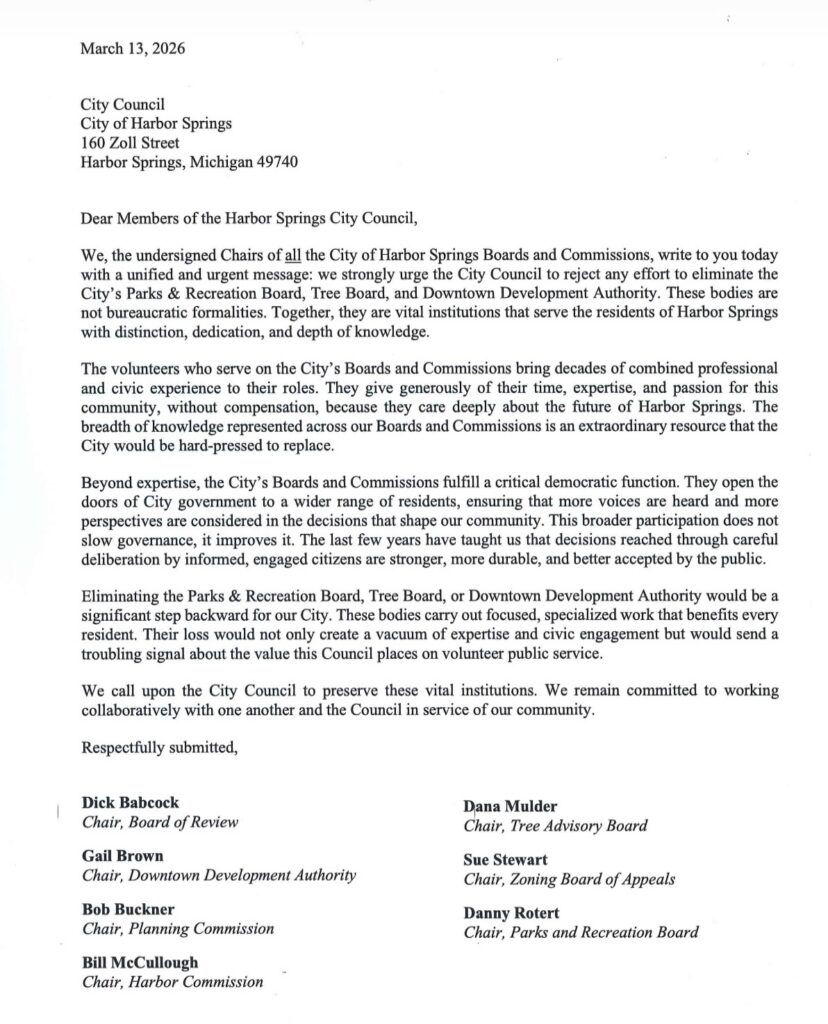
- Monday’s City Council agenda item on the Tree Board, Parks Board, and DDA is the opportunity to ask a better question: what does participation look like when you design it for 2026?
- Other cities have replaced formal boards with open, technology-assisted models that include more people, cost less staff time, and produce cleaner results — including turning passive supporters into active donors without ever asking for money.
Start With What Everyone Agrees On
Two legitimate goals were in tension during Monday’s agenda.
Some on Council want community involvement to stay strong. When residents have a real channel to weigh in on parks, trees, and downtown character, the city makes fewer decisions that surprise people. That accountability is real and worth preserving.
Others want Council time focused on things that matter. A volunteer Council meeting twice a month to discuss items that have been circulating for years — the boardwalk, the bike path, the downtown study — without resolution is not serving anyone well. Neither is a governance structure that pulls limited staff time into administrative overhead for meetings that produce recommendations Council often acts on without full independent review.
Both concerns are valid. The question isn’t which one wins. The question is whether there’s a design that achieves both at once.
There is. The tools exist today. Other cities are using them.
Who Does Harbor Springs Belong To?
This is the question that rarely gets asked in city governance: who is the stakeholder?
The legal answer is simple: registered voters, residents of record. That’s who can serve on boards. That’s who counts in city elections.
The real answer for Harbor Springs is more complicated.
Harbor Springs belongs to the family that has owned a cottage on the bluff for four generations and considers this place home as surely as any address on their driver’s license. It belongs to the retiree in the Emmet County township with a Harbor Springs zip code who shops here, pays taxes here, and shows up to Planning Commission meetings. It belongs to the family that arrives in June and leaves in September — and has done that for 60 years. Their identity, their stake, and their financial investment in this town’s future are entirely real.
The current board structure counts none of them. You cannot serve on the Parks Board, Tree Board, or DDA if you are not a registered voter in the city. Roughly 60% of the people who consider Harbor Springs home — by any honest measure — are excluded from the formal civic engagement process by design.
The result is a civic structure that has quietly sorted the community into two groups: those who look like year-round voters and those who don’t. That sorting was never the intent. But it’s the outcome. And it creates a dynamic where people who share identical values about preserving this town’s character find themselves on opposite sides of a governance structure that was designed for a different era.
This is worth naming directly, because the anxiety during Monday’s agenda item is partly about this. Year-round residents who have invested years in these boards reasonably wonder: if the structure changes, do we lose influence? The answer is no — if the redesign is done right, the opposite happens. More people in the tent means more support, more resources, and more political weight behind the decisions that matter to everyone who lives here.
What the Current Structure Actually Costs
Before considering alternatives, be honest about what the current structure costs.
Staff time. Every formal board under Michigan’s Open Meetings Act requires public notice, a prepared agenda, recorded minutes, and staff attendance. The Parks Board, Tree Board, and DDA each carry this overhead every cycle — regardless of whether anything actionable is on the agenda. Some agendas are over 100 pages long.
Council bandwidth. Board recommendations feed Council agendas. Items that circulate through boards without resolution land on Council anyway, often without the analysis needed to make a decision. Two hours twice a month is a real commitment for volunteers. When a meaningful portion of that time goes to items that have been discussed for years without closure, the design is broken.
Volunteer burnout. The people serving on these boards are giving real time. But formal board service under OMA requirements — notice deadlines, quorum requirements, recorded votes — is overhead that drives away capable people, particularly those with professional expertise and less tolerance for process friction without results. The boards end up drawing from a narrow pool of available participants rather than the full range of people who care about the outcome.
Expertise gaps. The Tree Board was formed to address bluff stability — a real civil engineering problem in a town built around a 100-foot bluff with documented stability issues. There is no licensed civil or geotechnical engineer on the Tree Board. The formal membership structure hasn’t produced the expertise the board was designed to have.
Projects that never close. The boardwalk. The bike path. The downtown corridor study. Downtown art projects. These items have lived in board agendas and Council packets for years without resolution. That’s not a failure of the people working on them. It’s a structural outcome: when the accountability mechanism is “discuss at the next meeting,” items accumulate without closing.
What Michigan Law Actually Allows
Here’s something important that gets lost in this conversation.
Michigan case law has established that advisory bodies — committees that have no final decision-making authority — are generally not subject to the Open Meetings Act, because they do not “exercise governmental or proprietary authority or perform a governmental or proprietary function.”
That distinction matters enormously.
A formal board with delegated authority requires full OMA compliance: public notice, open meetings, recorded minutes.
An advisory committee that produces recommendations — which Council then acts on independently — carries none of that overhead.
The key test, following Pinebrook Warren v. City of Warren, is that when presented with a recommendation from an advisory body, the main legislative body should always take action on the recommendation separately, make an effort to review the recommendation, and not simply rubber stamp it.
This is the legal basis for a fundamentally different participation model. Harbor Springs can preserve community voice, add a digital input channel that reaches the 60% of the population currently excluded, and eliminate the administrative costs of formal board governance — simultaneously, within existing Michigan law.
What Other Cities Have Done
This is not theoretical. Cities of every size have restructured their participation models in the last decade. The results are documented.
Open advisory panels with digital input. Several small cities have replaced fixed-membership boards with open advisory panels — anyone who owns property, resides in the area, or has a documented stake can participate. No OMA overhead. No Council confirmation of members. The panel produces one prioritized recommendation document per year, submitted before the budget cycle. Community members who can’t attend in person submit input through a simple online form. The panel synthesizes that input. Council responds in writing within 60 days.
The effect on volunteer quality is worth noting. When you remove the process friction — the agendas, the quorum requirements, the formal votes — you stop selecting for people with time to sit in meetings and start attracting people with expertise, connections, and the ability to execute. A retired landscape architect who winters in Florida can now contribute meaningfully to a parks plan. A Chicago attorney who has summered here for 30 years can now weigh in on a downtown design question. The panel gets better, not worse.
Participatory budgeting. At least 64 cities and counties in the United States have conducted participatory budgeting processes, allocating over $360 million through direct resident votes. The model: a defined pool of discretionary funds goes to a community vote, with residents choosing between staff-prepared options. In Espoo, Finland, residents used a digital survey to decide how to spend €10,000 on a playground redesign. Involving residents in the process educated them about associated costs and reduced complaints to zero.
Apply that principle to Harbor Springs’ parks capital budget. Open the vote to all Harbor Springs stakeholders — not just registered voters. Run it online with an in-person option. People who learn enough about a project to vote on it also become its most credible advocates. They tell their friends. They write checks. They show up at Council when the funding is at risk. That’s a fundamentally different dynamic than asking a board to fundraise for a project most residents have never heard of.
Civic engagement platforms. Tools like PublicInput allow cities to run structured online consultations with real-time dashboards and customizable reports that turn public feedback into actionable insights, helping teams track participation, spot trends, and show impact. The seasonal resident in Chicago can weigh in on a downtown design question from their phone. The retiree in Bear Creek Township can respond to a parks priorities survey without driving into town. Input is captured, quantified, and presented to Council as a structured data set — not a stack of emails.
PublicInput is a commercial platform used by hundreds of cities including small municipalities. Decidim is the open-source alternative — launched by Barcelona in 2016, it now powers 485 instances across 32 countries, used by 306 public institutions and 169 organizations, supporting processes like participatory budgeting and policy consultation. It’s free, it’s configurable, and it has a strong implementation community. The Participatory Budgeting Project provides implementation support specifically for smaller jurisdictions.
The Fundraising Argument Nobody Is Making
Here’s a dynamic that the current structure completely misses.
When someone serves on a formal board, they become an insider. They know how decisions get made, what the constraints are, and why certain things are harder than they look. That knowledge is valuable — but it stays inside the board. Everyone outside is still asking “what is the city doing?” and the board is back in the position of explaining and defending.
When a broad community engages directly with a question — what should we prioritize in Shay Park? how should we spend the parks capital budget? — something different happens. People who vote on a project understand it. People who understand it advocate for it. People who advocate for it often fund it, without being asked, because they feel ownership over the outcome.
The cities that have run participatory budgeting consistently report this effect. Residents who voted on a playground redesign show up to defend it at budget time. Seasonal visitors who chose between park improvement options come back next summer asking how construction is going. The information that the board used to hold inside the process becomes the basis for a much wider community of support.
Harbor Springs has a large, dispersed community of people who care deeply about this town and have the means to back that caring with resources. The current structure doesn’t reach most of them. A well-designed engagement model for the committees and groups would.