
To our Readers – In hopes that the conversations during the April 16th meeting will go well, we asked Lynee Wells again for a letter on heights – it still was not clear to us – what may be missing in our new zoning code.. We hope that Beckett & Raeder will attend the meeting to assist in the outcome. Here it is. 
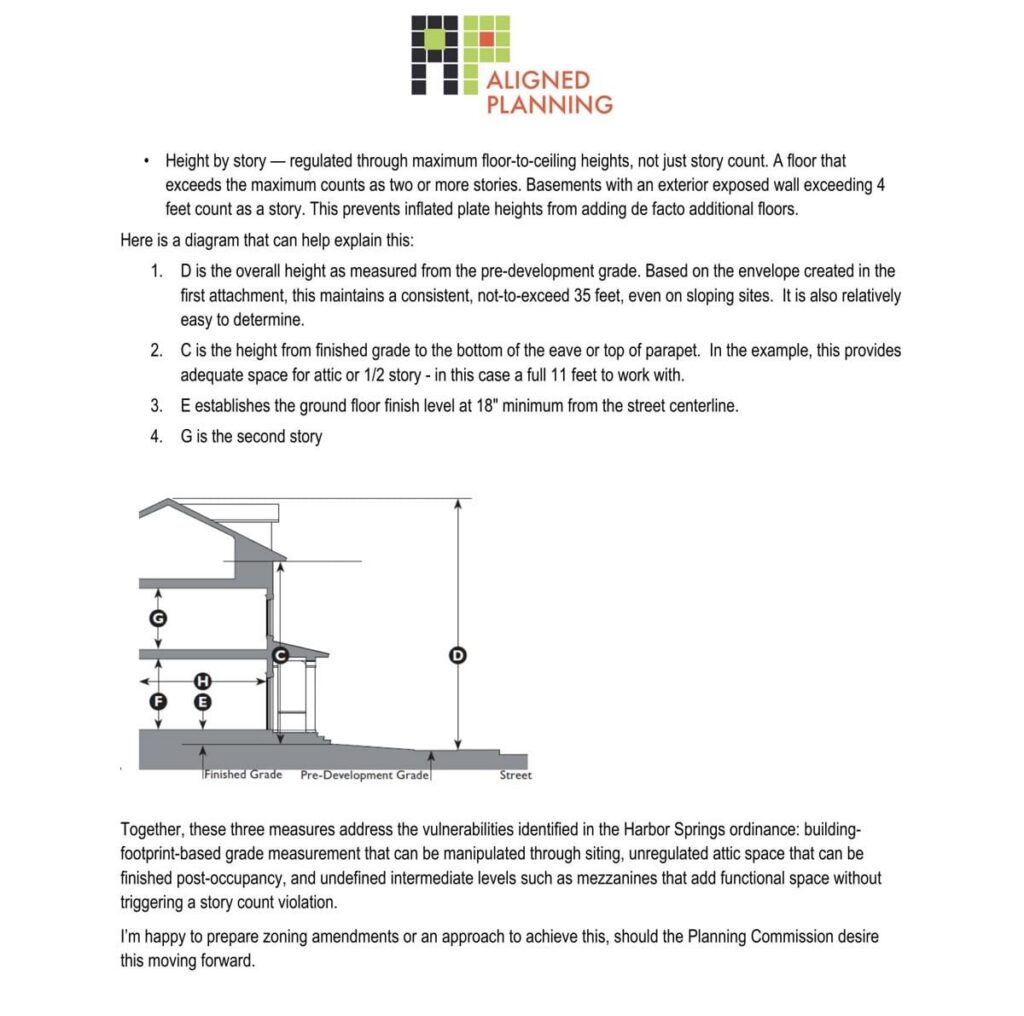
MARCH 16TH LETTER FROM LYNEE WELLS
TO PLANNING COMMISSIONERS & COMMUNITY

Page 5 End
The Planning Commission meeting for 3.19.26 was lightly attended by the public, John Lio, Karin Offield and Carter Williams and a panel of 5 Commissioners and Chip Everest and Mark Finkelstein on Zoom. The letter submitted by Lynee Wells only a few days before the meeting was met with a general – “what again, another letter from the We Love Harbor Springs’ paid Planning Consultant ? ” and “when will this stop?”
Giving some context to this reasoning is that when the Planning Commission agreed to discuss the Heights issue again in 2026 – a request by Chip Everest because of the “attention” about heights and that there was still community interest in the explanation of the subject – Lynee Wells was asked by We Love Harbor Springs to provide her expertise to the subject. As a peer to Beckett & Raeder, she found after a deep dive some inconsistencies and contradictions, and she gave her opinion of what examples she has witnessed in other towns, representing the facts either as a representative of a developer or representing a town. She describes her opinions as not just warnings to our community but gives elements that could be tweaked in the zoning code for more zoning protection.
The reason that she was brought into the discussions in August 2025 is because she is very familiar with Harbor Springs – having worked and written the Master Plan years ago for Harbor Springs and because the community we represent does not know or pretend to know the ins and outs of zoning lingo.
Do we think that the Planning Commissioners would listen a 3 minute public comment by one of us – tell them a mistake had been made – or an inconsistent fact has been made in their new code?
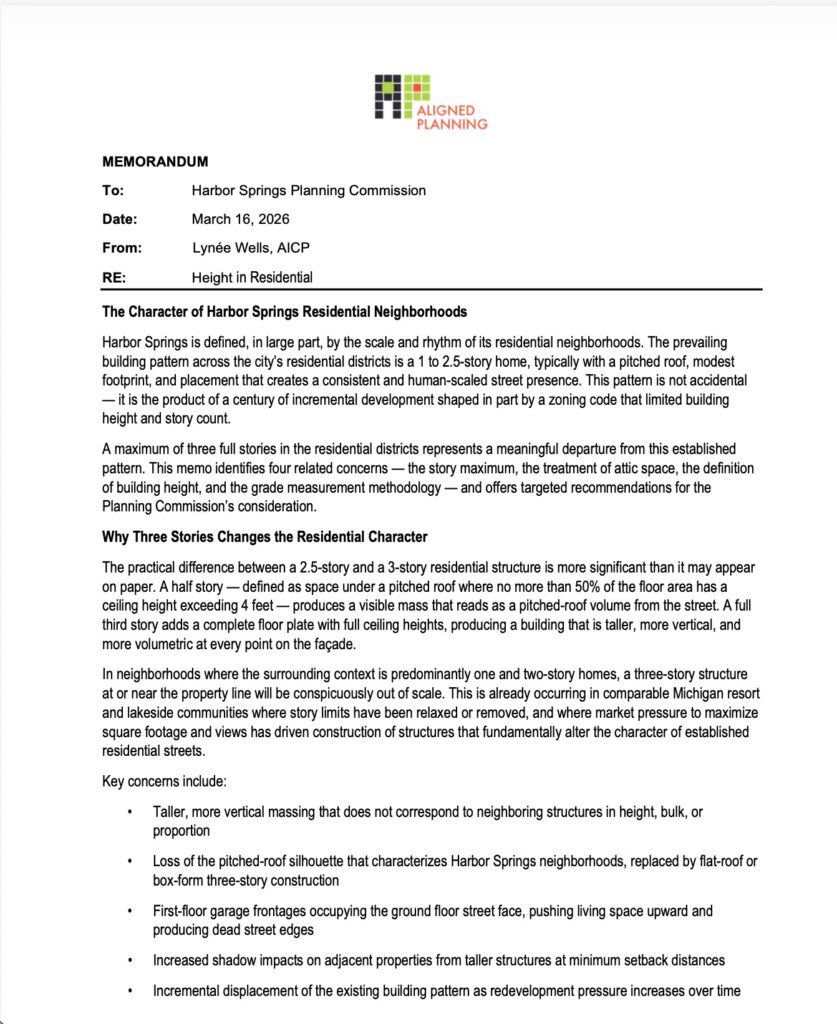
Here instead is a short summary of the points included in Planning Consultant Lynee Wells’ letter, which is meant to educate and to inform the discussion about heights and the stories allowed for buildings in residential and commercial areas of the city. This was a commitment by the Planning Commission at the December 2025 meeting, when the zoning code was recommended to Council for approval.
Six Warnings to Harbor Springs from the Height Memos
- Three stories will change the character of our neighborhoods.
Moving from the traditional 2–2.5 story homes to full 3-story buildings will make houses taller, more vertical, and more massive, and could slowly erase the human-scale look that defines Harbor Springs. - The new code allows more levels than people realize.
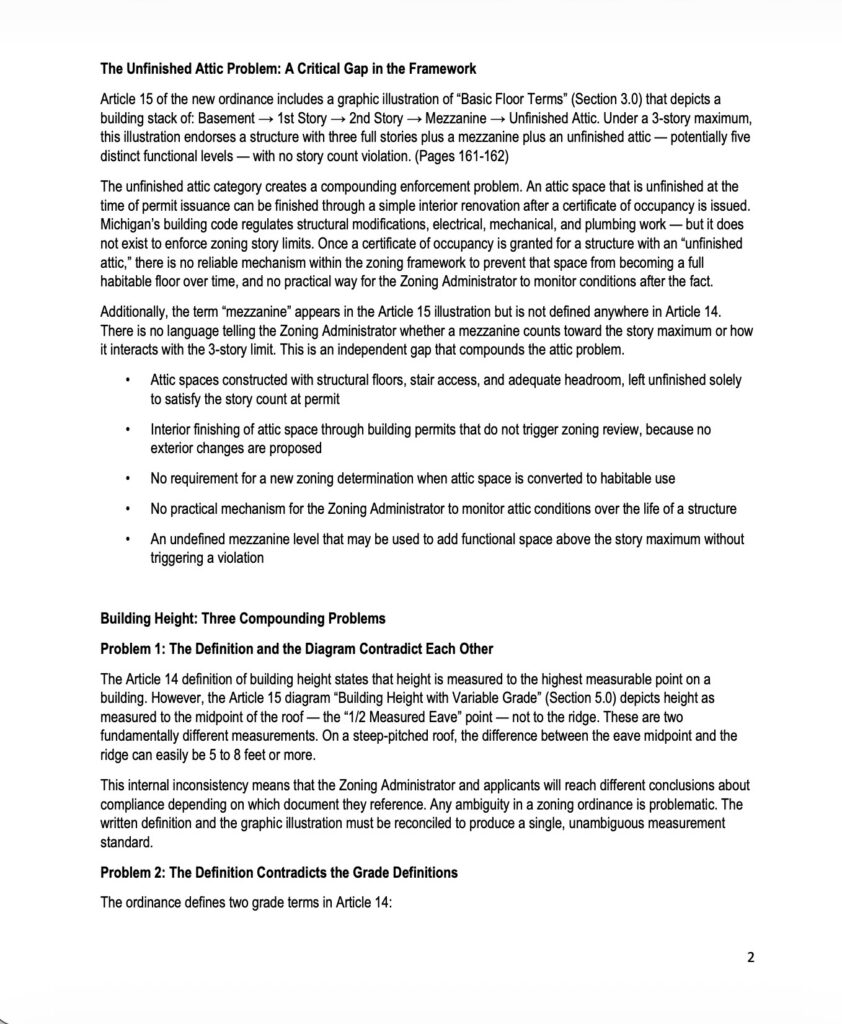
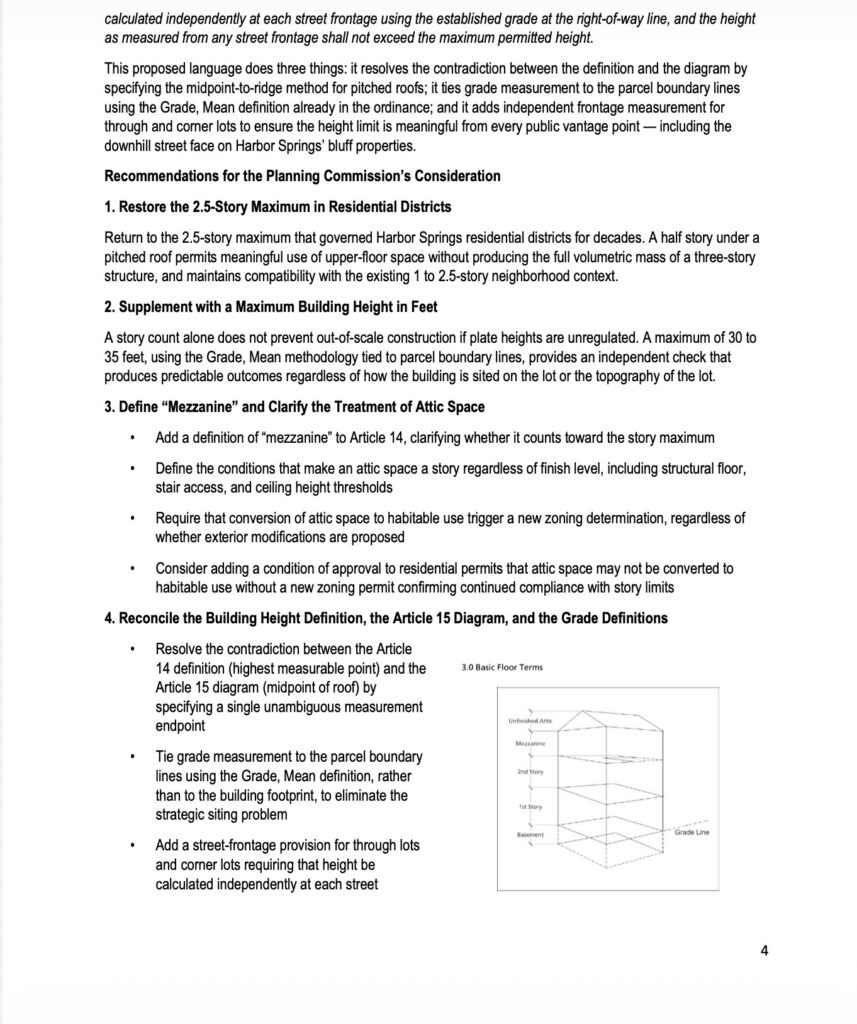
Because the ordinance allows attics, mezzanines, and unfinished space that may not count as stories, a house could end up with four or five usable levels without technically breaking the rules. - Once an attic is approved, the City may not be able to stop it from becoming another floor later.
After a Certificate of Occupancy is issued, interior work can turn an “unfinished attic” into living space, and zoning may have no practical way to enforce the original story limit. - The height rules contradict themselves, which could lead to bigger buildings than intended or more legal/interpretation battles with the Zoning Board of Appeals/Zoning Administrator and Applicants.
Different parts of the ordinance measure height in different ways, meaning applicants and the City could interpret the rules differently — usually in favor of taller buildings. - The current grade and height measurement system can be manipulated.
Because height can be measured from wherever the building is placed on the lot, developers can site, grade, or shape a project in ways that make a building appear shorter on paper but taller in real life. - If these gaps are not fixed now, the change will happen slowly — one permit at a time.
None of these problems may seem dramatic at first, but together they create a system where neighborhood scale can erode gradually, and once projects are approved, it becomes very hard to reverse the impact.
Submitted by Karin Reid Offield
From a post on the WWW
Here is her letter to download – you may have to be a code “geek” to follow. We are asking builders, architects, and person’s with an interest to chime in.
3.16.26 Residential Height Memo for Planning Commission 3.16.26
WHY ? Every winter we look at the snowbanks and wonder how they managed to get so tall. Of course, they don’t appear overnight. They grow one push at a time.
In the world of design, something similar happens. Somewhere, someone is always sketching the next house just a little taller, a little broader, a little longer than the last. Each change makes sense on its own. Over time, the street begins to feel different.
That is why the residents of Harbor Springs have spent so much time in meetings, workshops, and revisions — more than anyone expected — working to close the gaps that still remain. Not to stop progress, but to make sure the scale of what we build continues to fit the place we live. We are grateful to Lynee Wells for helping bring loose ends into our view.