
HARBOR SPRINGS WEEKLY DIGEST
Week of March 21–27, 2026
This Week
🔑 City Manager hired: Council unanimously approved a conditional offer to Chris Kukulski (current Billings, MT City Manager, Michigan native) at the March 18 meeting. Friday’s special meeting (Mar 27, 10 AM) was for formal employment contract approval. Per Petoskey News, Kukulski still has a 60-day notice obligation in Billings; earliest start likely in June. Read the Petoskey News Report Read the Petoskey News Story See more brief context below in the Section 2.
⚠️ Board debate began (Mar 18 Council): Mayor Graham at the DDA meeting explained he wanted a review and Councilwoman Reeve proposed a ballot measure to discuss/disband/change the Tree Advisory Board, Parks & Recreation Board, and DDA. All seven board/commission chairs signed a joint opposition letter. Discussion only — no vote taken. Read the 3.18.26 City Council Agenda & Packet Read the 3.18.26 City Council Agenda & Packet) See more brief context below in the Section 2.
📋 Planning RFP (Mar 18 Council): Mayor Graham proposed issuing an RFP for planning/zoning services; current provider Beckett & Raeder invited to re-bid. Context: Master Plan update approaching + city declined Redevelopment Ready Communities status. Discussion only — no vote. High stakes given 10–20 year master plan window. See more brief context below in the Section 2.
🏗️ Planning Commission (Mar 19): Public hearing on ADU at 417 E. Main St. (garage + 2nd-floor guest quarters; ZBA already granted variances). Also reviewed Kiwanis Park building improvements, Shay Park landscape plan (Master Plan consistency). Added CBD minimum story heights to discussion agenda and more on heights/grade/errors/ommissions on the next meeting agenda. Watch or listen to the 3.19.26 Planning Commission Meeting
🚴 Harbor Way/Wheelway extension revived: Harbor Inc.’s Doug Fuller sent a letter to Council urging the city to keep the Little Traverse Wheelway downtown extension alive post-staff departures. MDOT approved culvert in Feb 2023; engineering estimate ~$800K+, only ~$40K raised. No Council action taken yet.

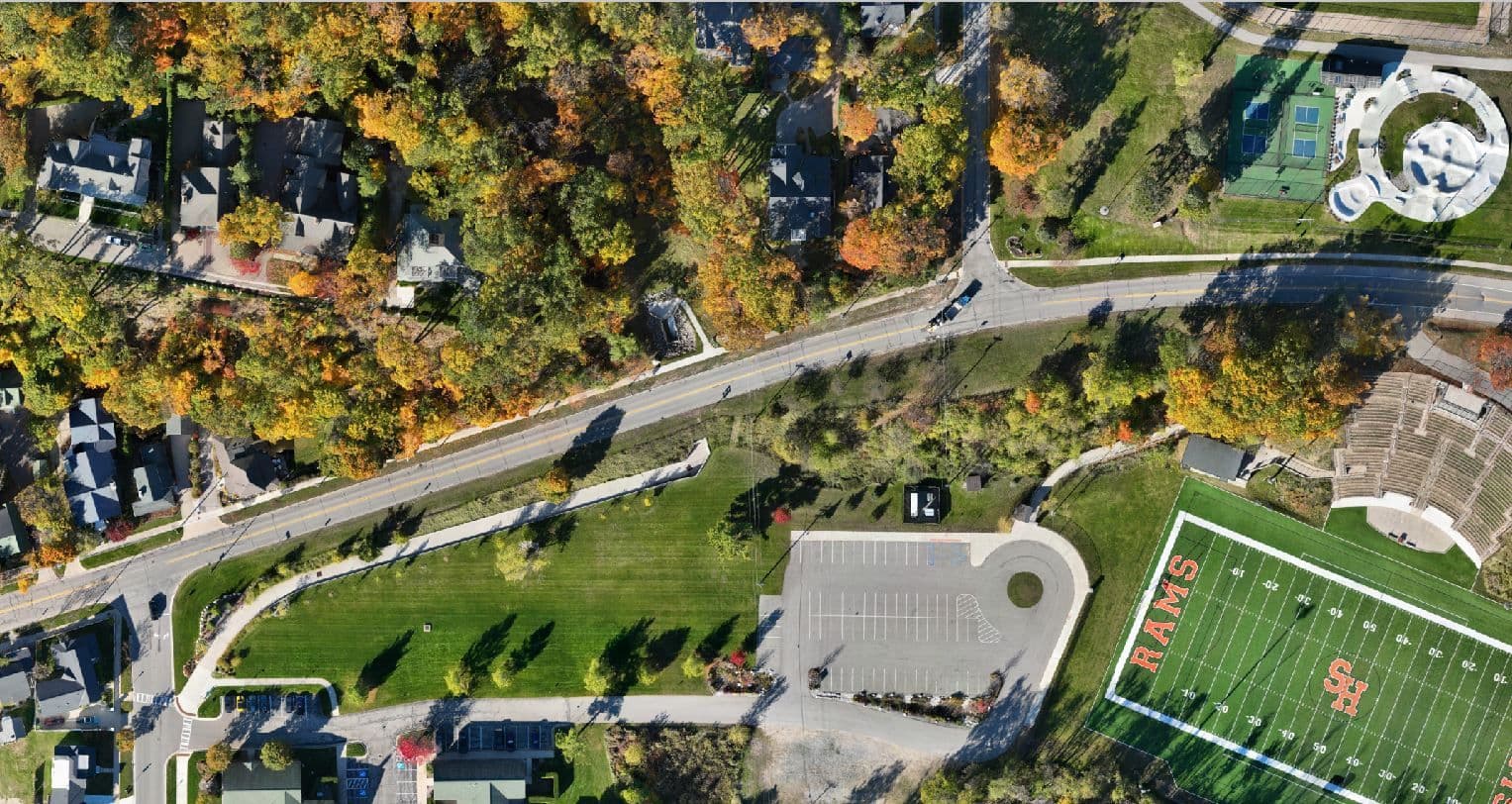
Entrance to Harbor Springs - Summer 2025
📊 DDA (Mar 11): ~$421K fund balance. Approved website rebuild, merchant social media training, geo-fenced marketing study. Streetscape master plan with Beckett & Raeder kicked off (target: 2026 plan, 2027 partial implementation). Watch the 3.11.26 DDA Meet
A few Thoughts
As Harbor Springs enters a period of administrative transition, is it a time to reaffirm the responsibilities within our council-manager form of government? The City Council sets policy and legislative direction. The City Manager implements those policies and oversees the city's day-to-day operations. What matters? More trees? Reliable snow removal? A stable utility grid? A sewer system that works? The direction you set as a community of voices will determine whether municipal resources are focused on residents' long-term needs or diverted to less essential priorities.
The community is very active in the tree board, parks and rec, and redesigning 3rd street to create more retail stores. But who is focused on the infrastructure? We have an $8M capital shortfall for the Utility and may need to spend an unexpected $2M on the sewer system. Is $800K for a bike path more important then $2M for the sewer? How do we balance what is easy to enjoy (Parks) with a complex duty to infrastructure?
If you consider Harbor Springs home, what are you doing to help set the priorities? Do the voices in the audience steer the priorities? Where are you?
-
Mayor Tom Graham urges city operations to be accountable and oversee projects like a well-managed organization. He sees reporting outcomes and costs not as a gotcha, but as a way to measure success, identify shortfalls early, and preserve Harbor Springs. He called for an annual review of all boards and commissions to assess return on investment. “I’d like to review everything you do every year in business... just curious how much money all the different boards spent or requested for spending across the city and what they completed.” He suggested board chairs present financial data and achievements annually. While nobody’s against a park bench, benches don’t generate revenue. The real question is whether boards are testing ideas, tracking what works, and showing results that justify investments.
-
Councilwoman Jamie Mielke has been asking for budgetary explanations for all costs related to events held on City Property. Whether that detail can be accumulated before the new City Manager takes a seat at the table, can her requests be gathered by the chairs of the Parks and Recreation (ie: Events) working with City Hall staff.
-
Councilwoman Wendy Reeve has consistently repeated the need to prioritize maintenance of existing infrastructure: sidewalks, waterfront facilities, and other essential assets. Before committing to and investing in new amenities or expansion projects. Every new project is the start of a 50-year cost to maintain and upgrade. Her focus on fiscal discipline and careful evaluation of capital priorities reflects the concerns many residents share.
-
Councilwoman Kathy Motschall, rather than critiquing the workmanship of the boards, Motschall has actively advocated for better training and support for volunteer board members. She strongly praised the creation of an orientation and expectation packet for new board members, drawing on her own experience joining the Zoning Board of Appeals (ZBA). She noted that it can be overwhelming to be thrown into voting on complex issues without prior background assistance, and stated that a clear understanding of board responsibilities is a great way to start.
-
We found that Councilwoman Jeannie Benjamin questions the City’s role in entertainment. When asked which types of spaces or parks the city should prioritize, Benjamin questioned the need for extensive municipal programming. She stated, “Is it the city’s responsibility to make sure that people are entertained? I think our parks are beautiful,” suggesting that with the natural amenities available (water, kayaks), the city does not have the population to justify heavily organized activities. It makes you wonder, should Yoga in the park be organic from the community (as it is) or planned? Benjamin’s focus has been on overall budget prioritization.
These perspectives point to a clear and practical principle: before expanding amenities, continuing “as we have done in the past” or undertaking new initiatives, should the city secure the reliability and sustainability of its essential systems? Only the city can manage DPW, public safety, and the utility.
By aligning around shared priorities and strengthening the foundation first, Harbor Springs also has an opportunity to build its own bridge across the community and move forward with greater clarity, trust, and long-term stability.
DDA: The newly initiated Streetscape project ($22,500.00 study paid) seeks to rethink commercial operations on 3rd Street, increase retail, and beautify the city. Are you interested in a study to figure out how to spend millions to reshape 3rd street? We spent $1M on essentially a cosmetic upgrade to the harbor master building. Dollars well spent?
Zoning: The city’s continued reliance on Beckett & Raeder International (BRi) as its planning consultant raises a fair question. BRi drafted the first zoning update. The Planning Commission approved it unanimously. Voters overwhelmingly rejected it. Citizens then stood up, rolled up their sleeves, and shaped the next version themselves. BRi drafted at the direction of citizens and the Planning Commission. That version also passed unanimously. The difference wasn’t the commission or the consultant. It was listening to residents from the start. A good consultant would have told them that on day one. Instead, it took three years of misdirected effort to arrive where we could have begun.
There’s a bigger question worth asking. The state hired BRi to draft its strategy for standardizing zoning across Michigan. New legislation from Lansing seeks to strip away key elements of local zoning control. So when Harbor Springs relies on a BRi whose other client is actively working to override local decision-making, whose playbook are we running? If Harbor Springs wants to preserve what makes this town feel like home, now might be a good time to rethink the role of the city’s planning consultant. Are we looking for someone who follows the lead of our citizens or the legislature?
As the city moves forward now, it may be prudent for the Council to evaluate by an RFP whether alternative planning partners could be a better choice to facilitate the future, transparent, and community-driven planning. After many years of saying the community is not engaged, these decisions can now come from discussions among many.
A Request for Proposal (RFP) for zoning consultants has been brought to the City Council for discussion, and the City Council sent the discussion to the Planning Commission for more discussion. Harbor Springs is at a pivotal moment. After several years of working with the same planning consultant, it is both responsible and standard practice to issue a Request for Proposals (RFP) to ensure the city receives the best available expertise, perspective, and value.
An RFP is not a criticism; it is good governance. It invites fresh ideas, allows for comparison, and reinforces public confidence that decisions are being made with transparency and care. In a small, fully built-out community like ours, where each planning decision has lasting impact, taking the time to evaluate options is not a delay. It is due diligence.
Can we have a Utility Board? Residents have spoken up. Is now the time for the city to shift its priorities toward strengthening foundational systems: sidewalks, electrical reliability, storm preparedness, sewer, and other critical infrastructure? The recent ice storm showed just how vulnerable our electrical systems are. The next City Manager and City Council should put the security and resilience of Harbor Springs’ electrical infrastructure at the top of the list, if not number one.
Harbor Springs is a small community with finite resources: The perspectives already expressed by members of the current Council, emphasizing stewardship of public assets, fiscal responsibility, and infrastructure maintenance, offer a constructive foundation on which new leadership can build.
Our Ask: We encourage the City Council to guide the city toward policies that strengthen infrastructure, consider how to preserve Harbor Springs character, and ensure that public resources are directed first toward the towns’ utilities and then to the needs of the residents, full-time and seasonal, who consider Harbor Springs home.
Sincerely, We Love Harbor Springs
We Love Harbor Springs is a community advocacy group committed to fair, transparent processes consistent with federal and state law. We do not direct City Council or City Hall. We participate as residents by attending meetings, reviewing public documents, and sharing information.
The Harbor Light in their recent Wednesday paper labeling citizen involvement as ‘self-appointed’ certainly mischaracterizes ordinary civic participation and risks discouraging the engagement that open government depends on. Public participation is not a problem to solve. It is a cornerstone of accountable government. Our focus remains on process, transparency, and informed community discussion.
Sources
-
Attending meetings, transcripts, meeting minutes and interest in the goings on in Harbor Springs.
-
International City/County Management Association (ICMA). The Council-Manager Form of Government. ICMA explains that in the council-manager system, the elected council sets policy and legislative direction, while the city manager is responsible for implementing those policies and overseeing day-to-day municipal operations.
-
National Civic League. Model City Charter (9th Edition). The Model City Charter describes the council-manager system as one in which the council establishes policy priorities and the professional manager administers municipal services and operations.
-
Michigan Municipal League. Handbook for General Law Village and City Officials. The handbook notes that Michigan city councils establish policy and fiscal priorities, while the city manager carries out those policies and manages the administration of city departments.
-
International City/County Management Association (ICMA). Effective Working Relationships Between Councils and Managers. ICMA emphasizes that clear policy direction from the council and professional administrative execution by the manager are essential for effective local governance.