
Responsibility for Height
To ensure correct decision-making, adherence to State Law and the City Charter, and to avoid placing the City and its inhabitants and taxpayers at risk. While we are going to discuss adding parking for consensus, we’d like the three other items, PD’s; Heights/Grades; & final language approval of the ARC to the deep dive that was agreed upon at the Planning Commissions first January Meeting.
We believe we are asking exactly the right question—and this is where the conversation or argument becomes protective, not oppositional.
Below are three worst-case scenarios, written so they can be spoken aloud or briefly written, and framed around why protection matters in Harbor Springs, not why planners are “wrong.”
These scenarios explain why Beckett & Raeder’s “modern zoning / future-ready” approach conflicts with what the community is asking for now.
In Harbor Springs, the risk isn’t dramatic overdevelopment—it’s incremental approvals that permanently change scale while technically following the rules.
Clear height language isn’t about stopping development—it’s about making sure what gets built still feels like Harbor Springs after the permits are closed.
1. HEIGHTS: “Out-of-Scale by Right”
Worst-case scenario:
Height standards become flexible enough—through PDs or administrative interpretations—that homes or buildings technically comply with the code but are visually and contextually out of scale with their neighborhoods.
What that looks like in practice:
- A structure meets height limits on paper but dominates adjacent homes due to massing, roof form, or grade manipulation
- Neighbors are told, “It meets the ordinance,” even though the outcome clearly violates neighborhood character
- Once built, there is no remedy
Why this matters in Harbor Springs:
Height is not just a number here—it’s about views, sunlight, privacy, and the human scale of streets that were never designed for oversized structures. Without clearer guardrails, enforcement becomes defensive instead of protective.
Plain takeaway:
If height controls aren’t precise, the code protects measurements—not neighborhoods.
Real Life Examples:
The “Compliant but Overwhelming” House
Scenario:
A new home technically meets the height limit, but through grade manipulation, roof form, and stacked massing, it towers over neighboring cottages.
What happens:
- The applicant measures height from the lowest allowable point or the average of the four corners
- A tall foundation + steep roof + multiple stories stay “within the number”
- Neighbors lose light, privacy, and scale—but are told it complies
Why this matters in Harbor Springs:
Many neighborhoods were built before modern height calculations existed. Without clear limits on massing, roof form, and grade, height becomes a math exercise instead of a character safeguard.
Gauge question for the code:
Does the height standard protect neighborhood scale—or just numeric compliance?
The View Corridor Loss
Scenario:
A structure meets height limits but blocks long-standing public or neighbor views of the harbor, lake, or bluff—views that were assumed protected by custom, not written rule.
What happens:
- No explicit view or step-back standards exist
- Height is measured, approved, and irreversible
- Long-considered “shared” views disappear overnight
Why this matters in Harbor Springs:
Views are part of the town’s identity and property expectations, even when informal. Once lost, they cannot be restored, and resentment lingers long after permits are closed.
Gauge question for the code:
Does the height language recognize Harbor Springs’ topography and view sensitivity?
The Downtown “One More Story” Effect
Scenario:
A downtown building seeks an additional story or taller mass through interpretation, PD flexibility, or ARC review—arguing economic viability or consistency with “future vision.”
What happens:
- A small increase is approved as reasonable
- That approval becomes precedent
- Within a few years, downtown scale quietly shifts upward
Why this matters in Harbor Springs:
Downtown is compact and human-scaled. Even small height increases compound quickly and permanently alter street character, shadows, and the pedestrian experience.
Gauge question for the code:
Does the height standard prevent incremental escalation—or enable it?
At the next Planning Commission meeting on March 19th, 2026 the Commissioners will re-start the discussion on height. Please attend to participate. Included here is Lynee Wells report on the importance of making sure height, scale and neighborhood character is not lost, but protected in our new zoning code. If you show up and have an opinion, the Commissioners will listen. Thank you.

February 10, 2026
Height Memo for Planning Commission 2.2.26
3 Pages – Heights and regulations in CBD and in Residential neighborhoods vary in many ways, many are still confused why we want to review the Heights subject again. So for many of us that are participating in the zoning process. Lynee Wells provides us with details that makes it simpler to understand. Hope this report is helpful. Below the letter you will also find the Height questions poised in September/October 2025 – From the 60 Issues Questions #22-27
Please join the Planning Commissioners meetings on Thursdays once a month to learn more.
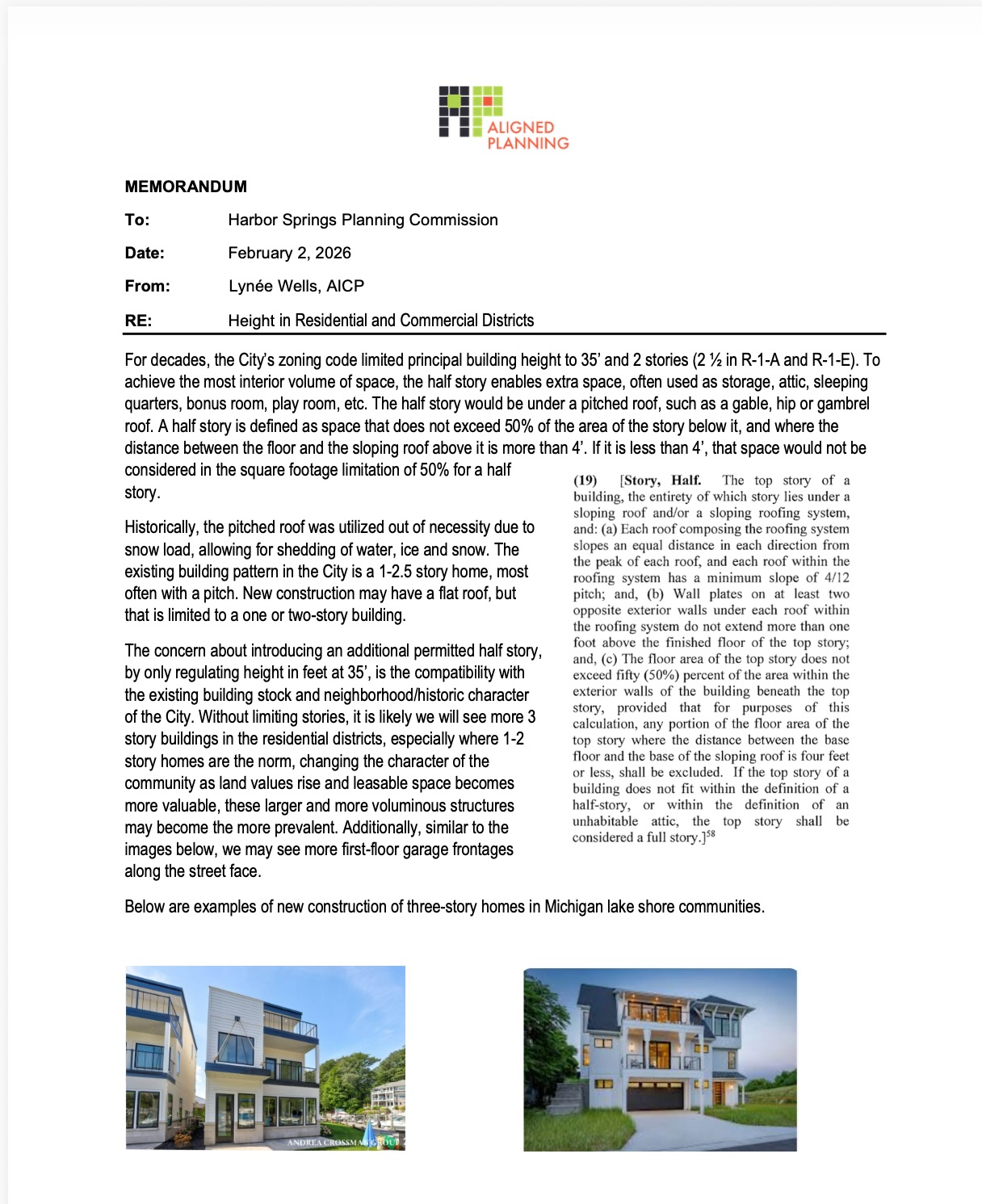
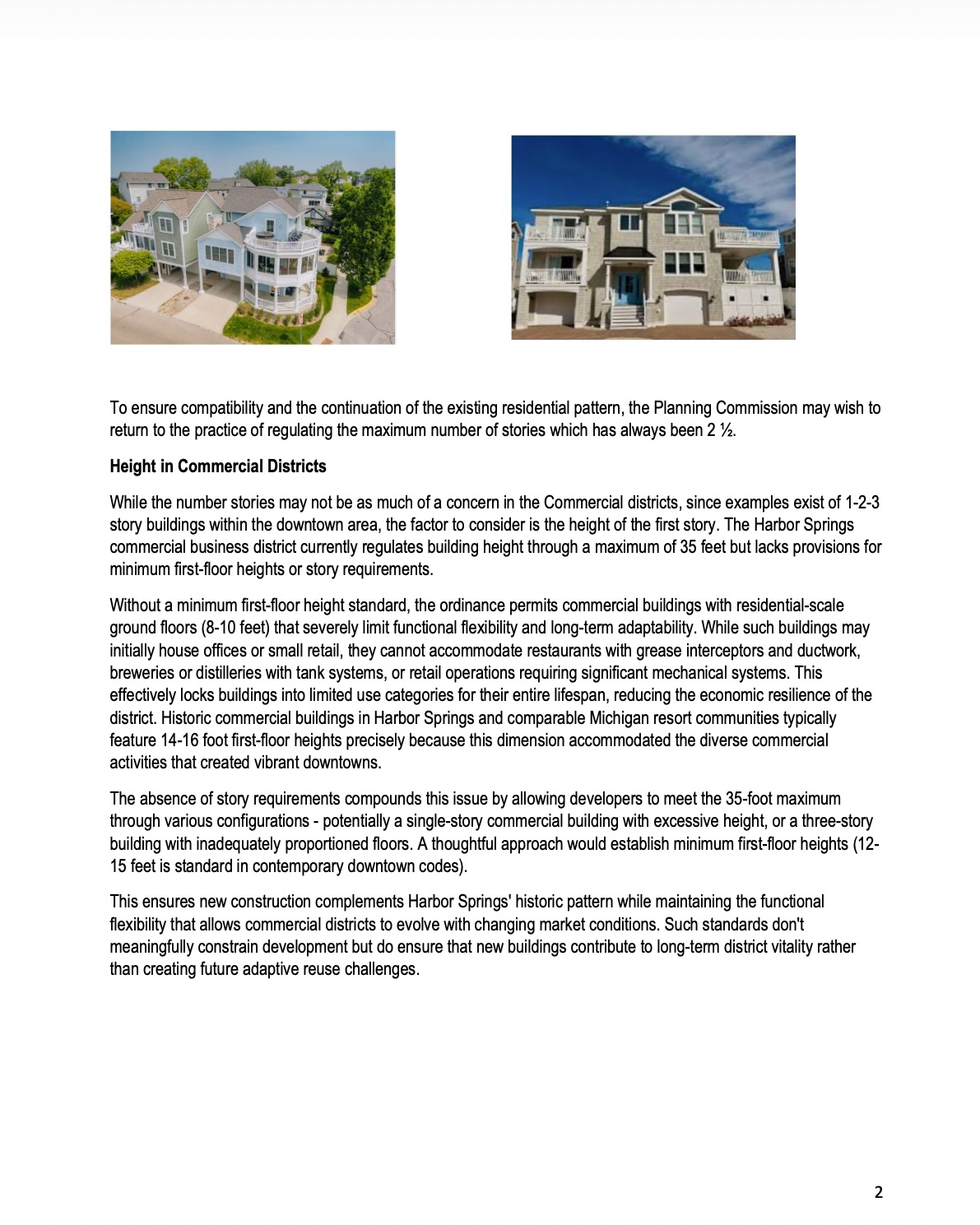
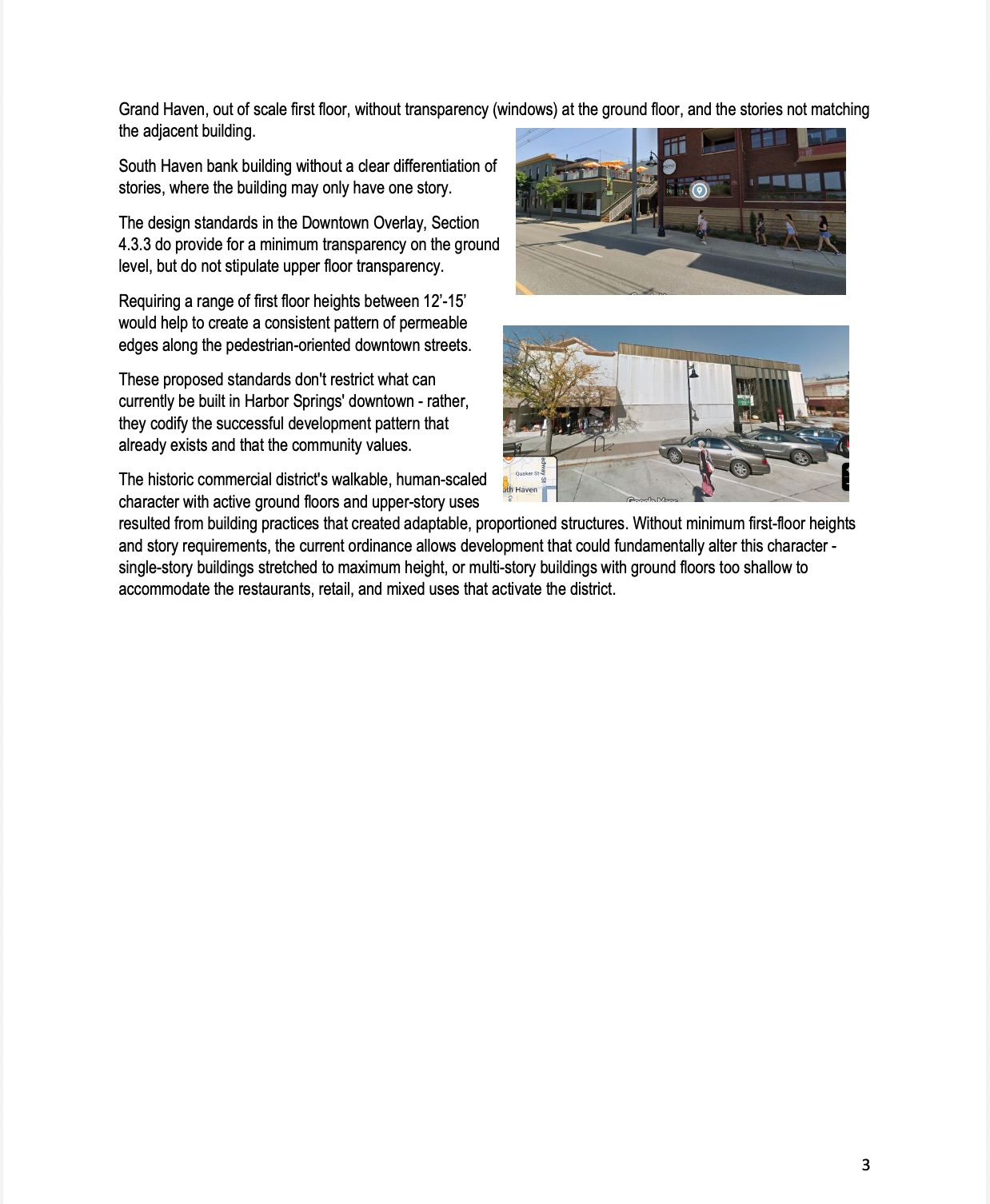
For more information on the building and reasoning of the NEW zoning code and Heights See Chairman Mulders responses in red. – See Questions 22-27 on that subject…for the full 60 questions go to this LINK: https://weloveharborsprings.org/zoning/harbor-springs-10-10-2025-sixty-issues-the-community-has-raised/
Building Heights Question 22. Issue: What are the new height limits for buildings? Do elevators, tanks, fans, fire walls,
antennas or parapet walls count toward the height? Where is this explained in the draft code?
Point of View: Height definitions vary across sections of the draft. Certain rooftop features may
be exempted, while others count toward total height. Residents should review the definitions
and height table in the zoning draft to confirm where exceptions apply. The Planning
Commissioners should discuss this with the community.
Response: Disagree. Section 5.23, Permitted Height Exceptions is clear and applies in all
districts. The maximum building height for each zoning district is shown in the tables in Section
3.4.X.
23. Community District Building Heights
Issue: Is it true that buildings in the Community District can be up to 40-ft high? Why is that
allowed, and why isn’t there a maximum floor area listed?
Point of View: Yes, the draft sets a 40-ft maximum height. The rationale appears to be to allow
larger mixed-use or commercial buildings. Floor area maximums are not listed, leaving total
building size open-ended. Up to subjective review?
Response: The PC elected to continue the same dimensions for the Community district as
exist in the current zoning code. I do not recall any concerns about the existing standards.
24. Height in CBD (35 ft vs. 38.6 ft)
Issue: The CBD chart shows 35 ft plus 42 inches, equaling 38.6 ft. Is the true maximum 35 ft or
38.6 ft?
Point of View: The draft’s height table is inconsistent. Clearer rules are needed.
Response: Disagree. The 35’ maximum height is clearly described in section 3.4.10. as is the
42” mechanical equipment specification and setback requirements.
25. Roof Decks, Elevators, Rooftops
Issue: How are features like roof decks, parapets, or elevators measured in building height?
Point of View: The draft is unclear. Without clarification, these features may exceed limits.
Response: Disagree. Section 5.23, Permitted Height Exceptions wording is clear and applies in
all districts.
26. Heights in B-2 District
Issue: Is the General Business B-2 district limited to 30 ft? Do decks and rooftops count?
Point of View: The draft mentions 30 ft but does not explain what is included. This requires
clarification.
Response: Section 3.4.12 shows that the maximum height is 35’. Section 5.23, Permitted
Height Exceptions is clear and applies in all districts.
27. Height Definitions (Draft 8.7.25)
Issue: Section 3.3.4.b defines height in ways that are confusing—existing, finished, average,
absolute. Which is correct?
Point of View: The draft provides multiple definitions throughout the draft but for me without
clarity. Can you explain?
Response: Article 14 – Definitions and Article 15 – Illustrations describe these regulations.